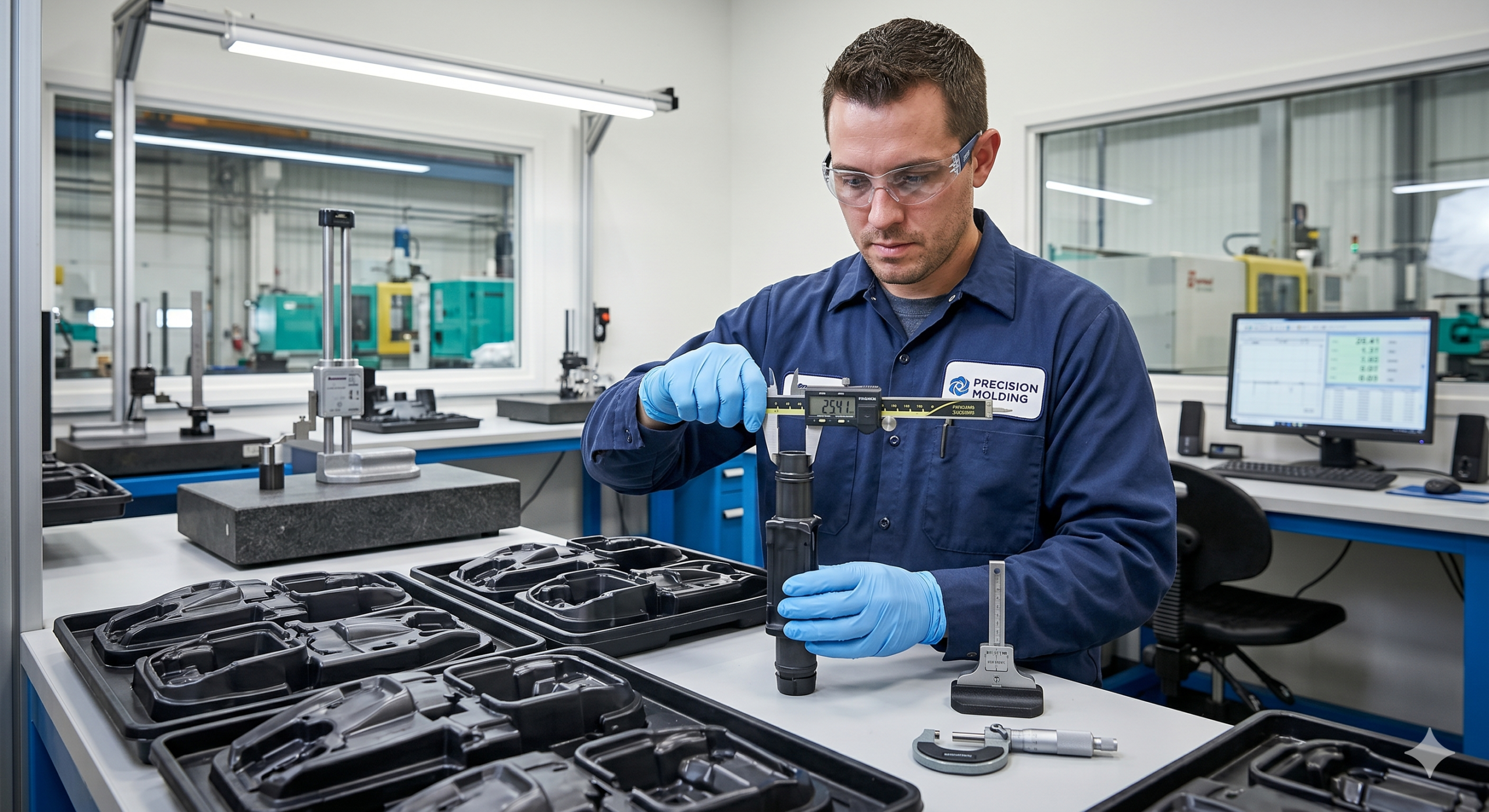
Quality systems are often overlooked in injection moulding, even though they are what determine whether production remains consistent over time. You can have the best machines, the most experienced operators, the finest-grade materials. And still produce inconsistent parts. Without a solid quality system, you're basically hoping each shift produces the same result as the last.
How Do Quality Systems Prevent Defects?
In injection molding, there is an important difference between prevention and detection. Detection catches problems after they've been incurred. Prevention stops them before they start.
A proper quality system under plastic injection moulding works on multiple levels:
- Process parameter control: Defined and locked injection speed, pressure, temperature profiles that are validated and then not changed without formal review.
- Incoming material inspection: Raw material batch testing, especially melt flow index verification, before it goes near a machine.
- Mould condition monitoring: This plays an essential role for scheduled tool inspections as run tracking on critical dimensions, and predict maintenance on cooling and ejection systems.
- Environmental controls: On ground level, humidity and temperature majorly affect both material behaviour and part dimensions in multiple ways.
- Statistical process control (SPC): Companies must track key dimensions over time to catch drift before it becomes an obstacle in the form of a defect.
Why is Consistency Important in Injection Moulded Parts?
Because your customer's assembly process is built around your dimensions. Their automated assembly line has fixed fixtures, clearances, torque settings.
If your part is 0.1mm out on a critical dimension today and within tolerance tomorrow, their line may run fine but confidence in your supply is destroyed. Understanding what injection molding tolerances engineers can realistically expect during manufacturing is the foundation of this conversation. — because a quality system can only control variation within the bounds of what the process is capable of holding
Long-term consistency means:
- Predictable assembly yields for your customer
- No process re-qualification events on their end
- Stable mechanical and cosmetic performance of the finished product
- Fewer warranty returns tracing back to moulded component variation
What Quality Standards are Used in Injection Moulding?
As per the sector you’re targeting, you'll come across the following standards:
- ISO 9001: The general quality management baseline, relevant across industries
- IATF 16949: Automotive-specific quality management, demanding advanced product quality planning (APQP), production part approval process (PPAP), and failure mode effects analysis (FMEA). These requirements don't stop at the molding stage — they extend into finishing too. Surface finishing requirements for automotive parts covers what IATF-aligned quality expectations look like when plastic components move into coating, painting, and surface treatment lines.
- ISO 13485: For medical device components, extremely stringent on documentation and traceability
- AS9100: Aerospace, with strong emphasis on first article inspection and process validation
Plastic moulding companies maintain quality documentation practices aligned with these standards. The specifics depend on the customer's sector requirements.
How Should Quality Inspections Perform?
This depends on the part criticality, production rate, and process stability. But here's a practical framework:
- Start-of-shift inspection: full dimensional check on first-off parts after tool warm-up
- In-process sampling: frequency based on historical Cpk and stable processes can go to hourly sampling; new tools or complex geometries need higher frequency
- Post-material-change inspection: any time a new batch of material is introduced, treat it as a potential process change
- Tool-change or maintenance inspection: full first article after any tooling intervention
Case Study: A consumer electronics client running 80,000 parts per week was doing end-of-day inspection only. They had a shift where a cooling channel partially blocked and parts were warping beyond tolerance.
Nearly the entire day's production was scrapped before it was caught. They implemented hourly CMM sampling on the critical snap-fit geometry. The same problem was caught 45 minutes into the next occurrence and 3,200 parts rejected instead of 80,000.
What Role Does Documentation Play in Quality Systems?
Documentation is the memory of your quality system. Without it, every problem looks like a new problem. With it, you can see patterns, trace root causes, and prevent recurrence. For manufacturers evaluating suppliers against these documentation and process control standards, how to choose an OEM auto parts manufacturer covers what to look for when quality system maturity — not just machine capacity — is the deciding factor
Critical documents in injection moulding quality:
- Control plan — what is inspected, how often, and what the reaction plan is
- Process FMEA — systematic analysis of what could go wrong and what controls prevent it
- Inspection records — actual measured values, not just pass/fail
- Non-conformance reports — what happened, root cause, corrective action
- Change control records — every process change documented with before/after data
For our hydro water transfer printing and foil stamping lines, documentation extends to coating process parameters too, not just the moulding stage.
How Do Quality Systems Reduce Production Waste?
Every defective part represents wasted material, machine time, operator time, and energy. A quality system that prevents defects at the process level saves all of that, continuously, every shift.
- SPC catches process drift before it produces out-of-spec parts
- Preventive maintenance avoids unexpected tool failures that produce scrap runs
- Incoming inspection stops bad material before it gets moulded
- Standardised setups reduce variability between shifts and operators
We've seen clients reduce their scrap rates from 4-5% down to under 1% within six months of implementing proper SPC and control plan discipline. At high volumes, that's a very significant cost saving.
Conclusion
Quality systems aren’t a support function in injection molding, they are the production system. The other components involved such as machines, materials, and operators only perform as per the command.
When processes are defined, monitored, and documented properly, consistency stops being a goal and becomes the default outcome. That’s what separates suppliers who “make parts” from those who deliver reliable, scalable production.
At Rustagi Polymers, our plastic moulding companies approach to quality is not about ticking certification boxes but delivering power performance.
FAQs
Q: How do quality systems prevent defects in injection moulding?
Through process parameter control, incoming material inspection, SPC, and preventive maintenance and stopping problems before they produce bad parts rather than sorting them out afterwards.
Q. Why is consistency important in injection molded parts?
Downstream assembly usually depends on stable dimensions. Even small variations can disrupt automated processes, reduce yield, and erode supplier reliability.
Q. What quality standards are used in injection molding?
Common standards include ISO 9001 (general quality systems), IATF 16949 (automotive), ISO 13485 (medical), and AS9100 (aerospace), depending on the application.
Q. How often should quality inspections be performed?
Based on process stability and part criticality, typically start-of-shift checks, periodic in-process sampling, and additional inspections after material changes or tooling interventions.
Q. What role does documentation play in quality systems?
Documentation enables traceability, root cause analysis, and continuous improvement by recording process conditions, inspection data, and corrective actions.
Q: How do quality systems reduce production waste?
By catching process drift early, preventing tool failures, and standardising setups, all of these factors reduce the rate of defective parts produced.