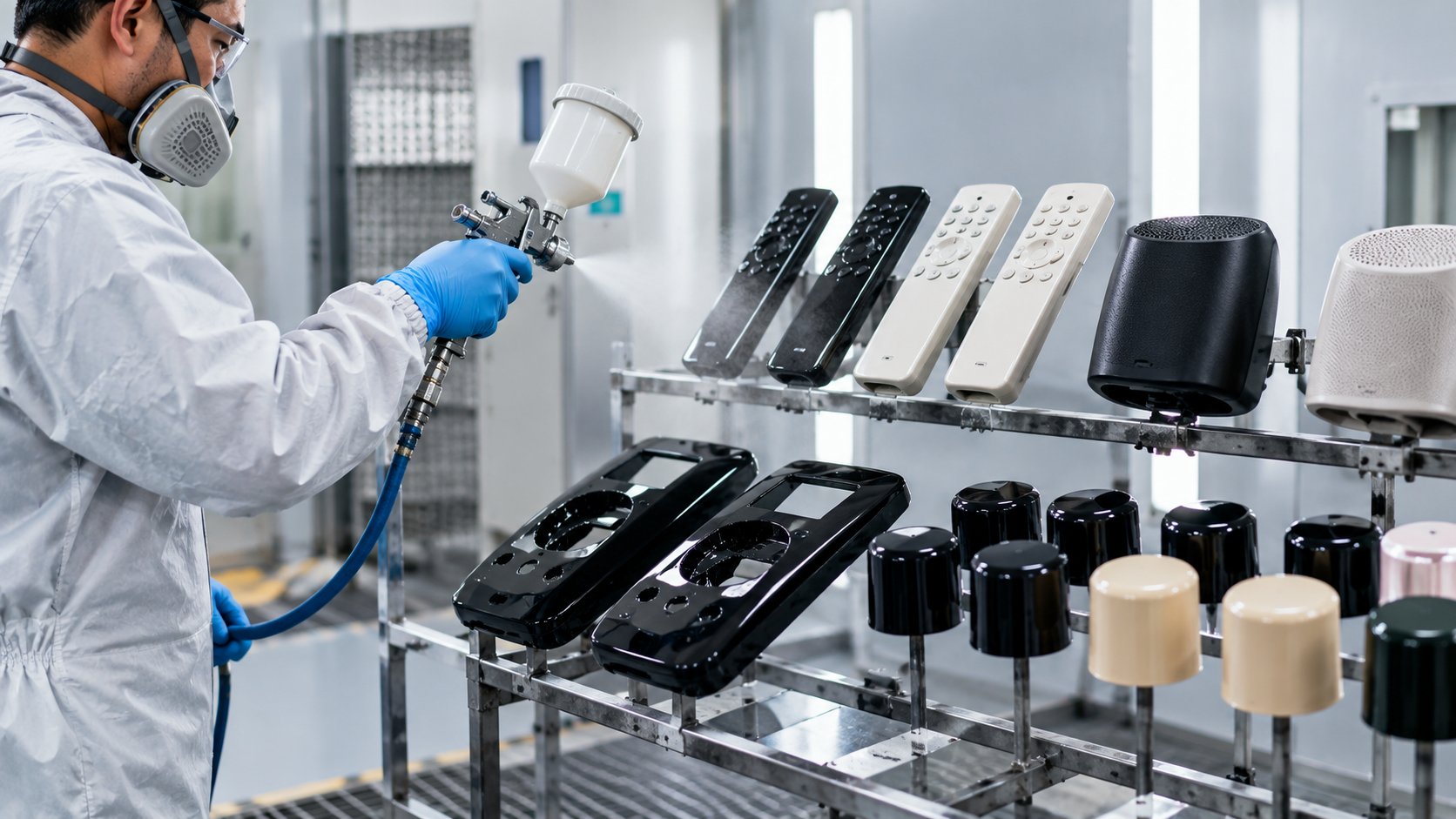
Consumer products live or die on how they hold up after the first few weeks of handling. Polyurethane (PU) coating is the finish most manufacturers reach for because it can be engineered rigid or flexible, glossy or matte, and still resist scratches, hand oils, and chemical exposure — provided it's matched to the right substrate and applied correctly.
This guide covers the chemistry behind PU, the practical differences between formulations, how plastic and mixed-material products get coated, and the tests a coating has to pass before a product ships.
The Chemistry and the Choices That Matter
A PU coating forms when an isocyanate reacts with a polyol, cross-linking into a dense, chemically bonded film — a fundamentally different, harder, more chemical-resistant process than an acrylic or enamel paint that just dries as a solvent evaporates.
Three formulation choices decide how it performs:
Aliphatic vs. aromatic. Aliphatic PU resists UV and won't yellow — the standard for anything exposed to sunlight. Aromatic PU is tougher against chemical immersion but yellows under UV, so it's reserved for interior components or as a hidden base layer under a UV-stable topcoat.
1K vs. 2K. A 1K system comes pre-mixed and cures on contact with atmospheric moisture — simpler to apply, but generally less chemically resistant. A 2K system mixes a resin and hardener just before application; most high-end consumer products use 2K for maximum durability.
Water-based vs. solvent-based. Water-based formulations have largely displaced solvent-based ones for their lower VOC emissions, without giving up the performance consumer products need.
Getting these three choices right for the actual use case matters more than the coating brand.
Coating plastic and mixed materials
Most consumer product substrates aren't easy to coat as-is:
Plastics resist bonding outright. Polypropylene and polyethylene have low surface energy — liquid beads up rather than wetting the surface, so a coating applied without prep peels or flakes. Plastic painting services solve this through degreasing, flame or corona treatment to raise surface energy, and adhesion promoters that bite into the raw polymer.
Mixed metal-plastic products need separate prep for each material. Metal typically needs media blasting and an anti-corrosive primer; plastic needs the treatments above. Only once both are prepped separately can a single PU topcoat go over both and read as one cohesive finish — the same metal plastic coating logic used for chrome-look automotive trim.
Thermal expansion mismatches at metal-plastic seams can crack a rigid coating; the coating system has to flex enough to absorb that difference rather than fight it.
Application process
- Prep — cleaning, then mechanical abrasion where needed to give the coating a physical profile to grip.
- Spray — HVLP guns for precision on complex geometries (electronics, small parts); robotic spray arms for consistent film thickness across high-volume runs.
- Cure — 1K systems can cure at room temperature over days; most manufacturing lines use heated curing ovens to accelerate 2K cross-linking without warping the plastic underneath.
Testing before it ships
A coating isn't approved on looks alone:
- Visual inspection under controlled lighting, with gloss meters, catches orange peel, runs, and color mismatch.
- Cross-hatch adhesion (ASTM D3359) — a grid cut into the coating, tape pulled rapidly; any lift is a fail.
- Taber abrasion (ASTM D4060) — an abrasive wheel under load simulates years of handling.
- QUV weathering (ASTM G154) — cyclic UV and moisture exposure compresses years of sun exposure into weeks.
- Thermal cycling between freezing and high heat checks that the coating won't crack from expansion mismatch.
- Chemical resistance testing against household cleaners, lotions, and hand oils.
Where it shows up
Soft-touch PU coats laptops, controllers, and wearables for grip and fingerprint resistance. Clear PU topcoats protect kitchen appliances from fingerprints and cleaning chemicals. Flexible PU formulations coat helmets and fitness trackers without cracking under repeated bending. Automotive interior accessories — dashboard trims, phone mounts — rely on it to survive cabin heat swings without warping or fading.
Working with Rustagi Polymers
Rustagi Polymers runs plastic painting and metal plastic coating alongside injection moulding from its Noida and Greater Noida facilities, so substrate prep, coating chemistry, and mold design get planned together rather than handed between separate vendors after an adhesion test fails.
That's the same integrated manufacturing approach covered elsewhere on this site, and it connects to mold cooling optimization as well, since cooling quality affects the surface the coating has to bond to.
FAQ
1. What's the difference between aliphatic and aromatic PU?
Aliphatic resists UV and won't yellow — use it for anything that sees sunlight. Aromatic is tougher chemically but yellows under UV, so it's for interior or hidden components.
2. Why does plastic need special prep before coating?
Common plastics like PP and PE have low surface energy, so coating applied directly beads up and peels. Flame/corona treatment and adhesion promoters fix that.
3. Can PU coat a product that combines metal and plastic?
Yes — each material gets prepped separately (anti-corrosive primer for metal, adhesion promoter for plastic), then a single PU topcoat unifies the finish.
4. How is a PU-coated part tested before it ships?
Cross-hatch adhesion, Taber abrasion, QUV weathering, thermal cycling, and chemical resistance are the standard checks.
Bringing a consumer product to market? Get in touch with Rustagi Polymers to plan the coating alongside the substrate and the mold.