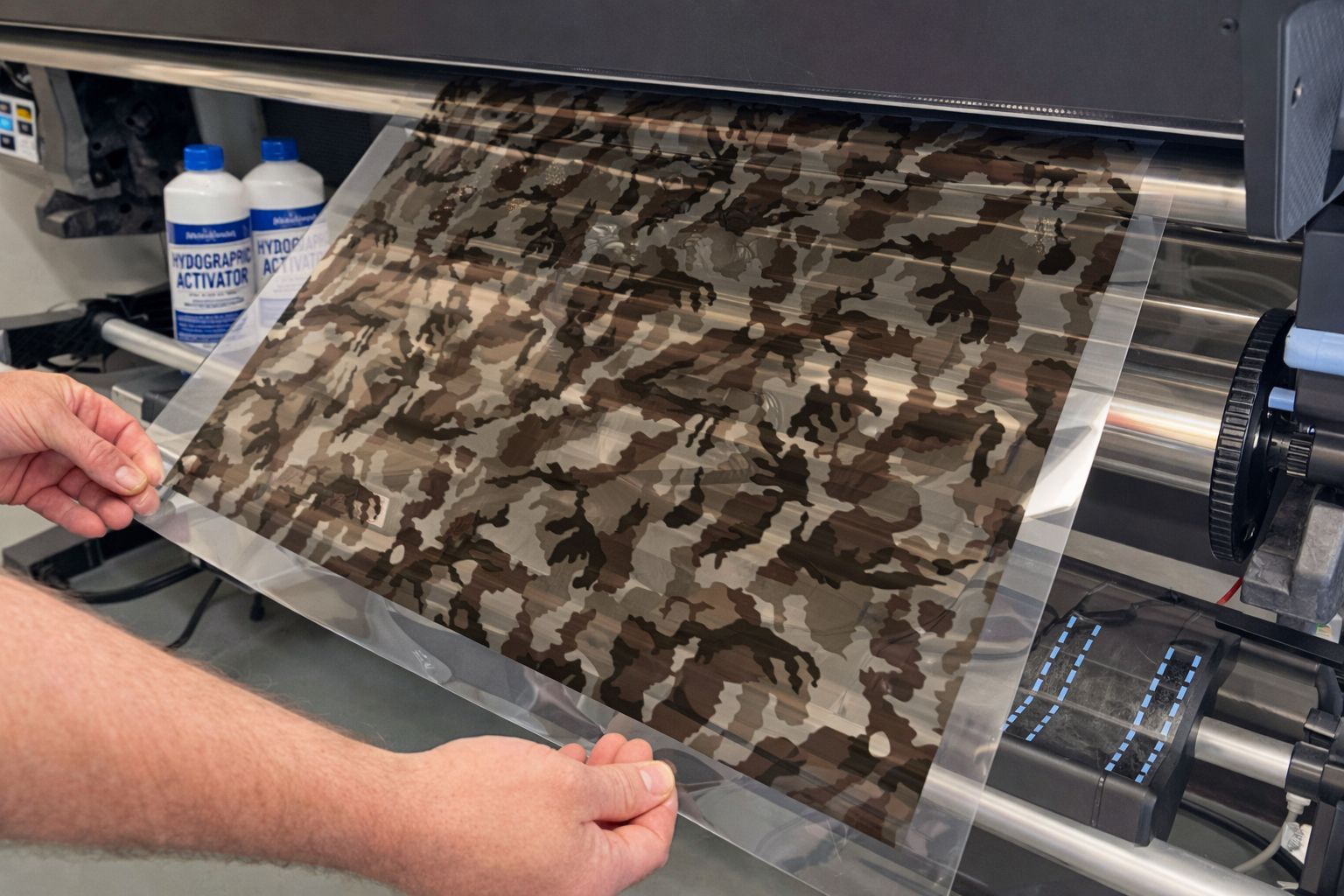
In hydrographic printing, the difference between a premium finish and a failed print often comes down to the quality of the film. Clearly, making its selection process a critical step in the process.
Let us understand how film selection plays an important role in hydro water transfer printing. First, let’s see why?
Why Film Selection Matters?
The type of film used affects multiple aspects of the final product in the following ways:
- Ensures consistent and high-quality finish
- Promises strong adhesion to the substrate
- Prevents blurry or stretched patterns
- Avoids uneven or low-quality results
- Enhances durability and wear resistance
When choosing finishes the quality of the film and the finishing options need to match to get the best result. If you want to know how choosing a finish affects how long it lasts and how it looks, you can read How to Pick the Right Foil for Colour Durability and Visual Impact
How selecting the wrong film affects the outcome?
- Blurry patterns
- Misaligned graphics
- Inconsistent finishes
Case Study: Hydrographic Printing for Gaming Controllers
A gaming controller manufacturer wanted to launch a limited-edition controller with a military camouflage finish to appeal to esports players and gaming enthusiasts.
Objective: To attract new customers, targeting esports players and gaming enthusiasts.
Challenge: To apply the camouflage pattern on the controller’s small, curved and highly detailed surfaces without losing pattern clarity.
Operations: To complete decorative finishing details containing multiple design elements, which includes:
- Small buttons and tight curves
- Textured grip areas
- Complex 3D contours
- High-touch surfaces prone to wear
When early samples were produced using low-resolution hydrographic film, the camouflage pattern appeared slightly blurred and stretched, especially around the edges of the grip and buttons sections.
Solution: To fix this error, the manufacturer made 3 major alterations:
- High-Resolution Hydrographic Film: A higher-quality camouflage film with sharper pattern resolution was replaced with the low-quality film to preserve fine details during transfer.
- Compatible Basecoat Colour: A matte olive-green basecoat was applied before hydrographics for strengthening colour depth and contrast.
- Protective Top Coating: A PU clear coating on plastic was applied after the transfer process to improve scratch resistance and durability.
Result: This resulted in the following benefits:
- Sharper camouflage pattern across small surfaces
- Uniform pattern alignment on curved areas
- Improved resistance against friction and sweat
- Premium matte tactical appearance
Clearly, we can see how hydrographic film selection directly affects print clarity and the overall appearance. Thereby, ensuring that even the minute details remain sharp on small, complex 3D components like gaming controllers.
Understanding Hydrographic Film
Hydrographic film is a water soluble printed film which is an ideal way to add a touch of personal style to your belongings. Below are the types of custom patterns and designs that are usually demonstrated:
- Carbon fiber textures
- Camouflage designs
- Marble patterns
- Wood grains
- Abstract graphics
During the hydrographic process, the film goes through a complex series of stages including:
- Floating on water
- Activated with chemicals
- Transferred onto the product surface
For example:
A motorcycle helmet manufacturer uses hydrographic printing by applying a carbon-fiber pattern onto curved helmet shells which is impossible to print using traditional flat printing techniques.
What factors affect the appearance of the design?
Multiple factors affect the hydrographic film selection, such as the following:
- Film pattern resolution
- Thickness
- Compatibility with basecoats
- Type of finish
The final quality of the prints depends heavily on the hydrographic film used. Let’s dive deeper into this.
What Factors Affect Hydrographic Print Quality?
1. Pattern Resolution and Design Detail
Hydrographic films are available in different print resolutions which differ in the following ways:
- Sharper patterns
- More realistic textures
- Better fine detail reproduction
2. Film Thickness and Transfer Stability
Film thickness plays a major role in how swiftly the film transfers onto the surface. Usually thin films lead to easy stretching while thicker films offer better stability and improved pattern alignment.
3. Surface Finish Options
The most common choice lies between gloss and matte finishes. The appearance of hydrographic prints depends on the combination of film design and protective coating.
Manufacturers often combine hydrographic prints with the following types of coating:
For instance, a sports helmet with a carbon fiber hydrographic film often uses a high-gloss PU clear coat for high shine. On the other hand, matte finish is used to coat objects like camouflage rifle sticks to avoid glare.
When we finish making things we usually do a lot of steps at the time. This can affect how long it takes to get everything done and how well the work gets done. Production schedules are very important. If you are making a production schedule, you can refer to What Affects Lead Time: Foil Type, Artwork Complexity, Supplier Workflow
4. Base Coat Colour Influence
Hydrographics films are usually semi-transparent, the base coat colour affects the brightness, contrast and depth of the final design. For instance, silver metallic colour will add depth and metallic reflections while black colour will create a darker, dramatic look.
5. Complex Surface & Substrate Compatibility
Flexible films are better suited for intricate 3D shapes and deep curves. Different materials such as plastic, metal, or composites require compatible films and surface preparation for long-lasting results.
Example
A plastic car dashboard panel might undergo primer coating, hydrographic transfer and protective clear coating. To create metallic effects beneath the pattern, manufacturers might apply vacuum metalising before hydrographic printing.
Conclusion
Many experienced manufacturers combine hydrographics with PU coating services on plastic or metal plastic coating to increase the lifespan of products manufactured in the automotive industry, consumer electronics and lifestyle products. Factors like resolution, thickness, basecoat compatibility, and coating determine how well a design transfers onto complex surfaces.
Choosing the right film ensures sharp patterns, consistent results, and a premium, long-lasting appearance. It defines the quality of the final output for delivering high-quality products. For more details, you can consider contacting experienced manufacturers like Rustagi Polymers.
Frequently Asked Questions (FAQs)
- What is hydrographics film and how is it different from regular printing film?
Hydrographics films allow you to apply detailed patterns and artwork to three-dimensional objects using the water transfer printing process. Unlike regular printing film, it dissolves in water and wraps around complex shapes during the transfer process.
- How does film pattern resolution affect final appearance?
High-resolution hydrographic films produce sharper patterns and more realistic textures while improving the durability and resistance. On the other hand, low-resolution films can result in blurry or pixelated designs.
- Which films are best for high-gloss and matte finishes?
High-gloss finishes are compatible with marble, carbon fiber, metallic pattern films and matte finishes work best with camouflage, tactical designs and stone textures.
- How does film thickness influence transfer quality and registration?
While thinner films conform easily to curves but might stretch more, thicker films offer better pattern stability and alignment during the transfer process.
- Are certain films better for complex 3D shapes or deep draws?
Yes. Flexible hydrographic films are specifically designed for high stretch capability and perform better on complex shapes such as fuel tanks, helmets and automotive objects.
- How does film compatibility vary by substrate?
Different substrates such as metal, plastics and other composites require specific primers and coatings to ensure hydrographic film adheres properly.
- What is the role of basecoat colour when selecting film?
Basecoat colour plays a major role in creating the final appearance of the objects as these films are semi-transparent and require an appropriate base for achieving a desired effect.