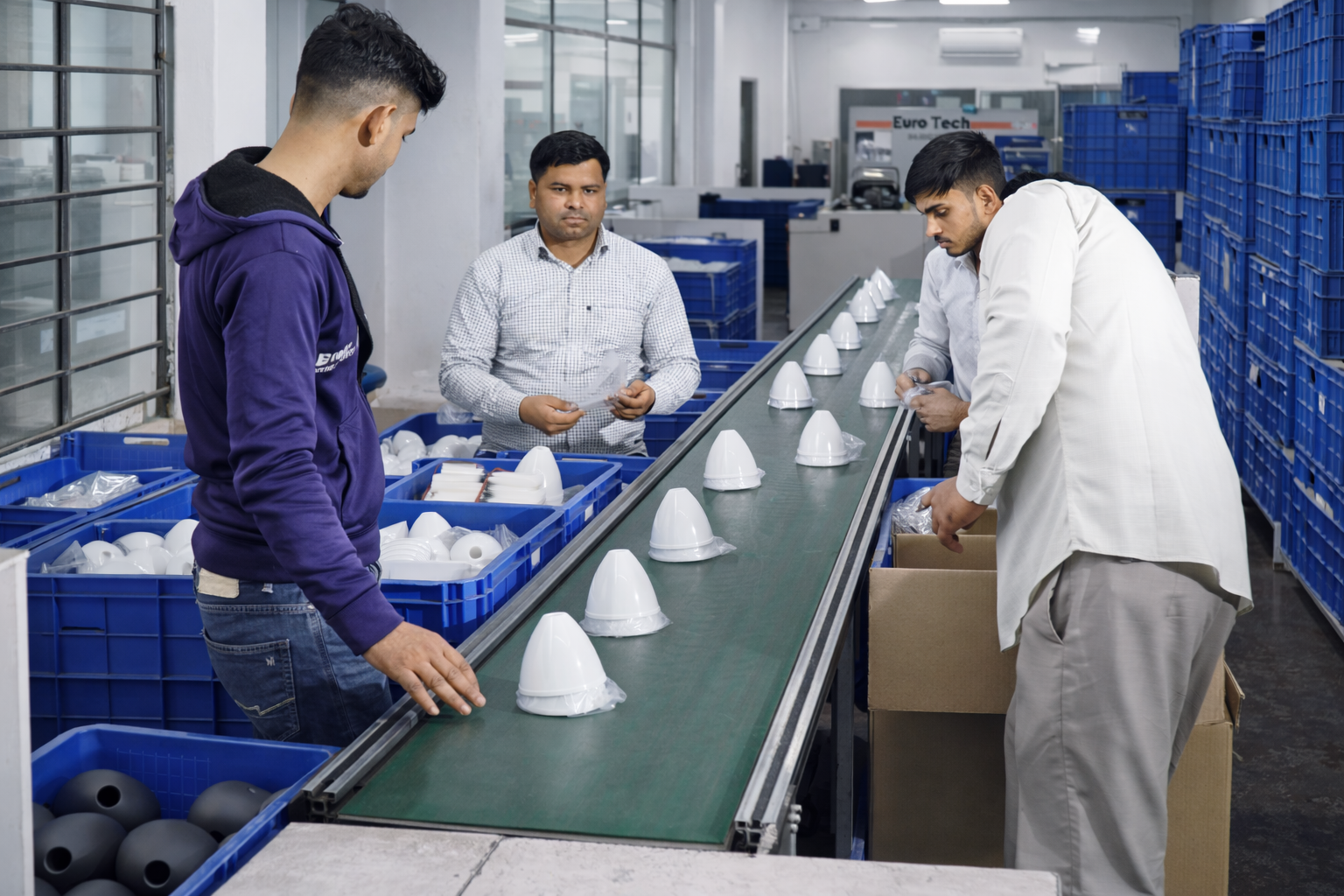
While countless hours go into PU coating services on plastic, there is a specific way plastic injection molding companies move from the design process to production. So, let’s start by asking where injection mold services begin.
The long and complex process might look intimidating at first glance but there are a few strategies that help avoid mistakes and make it a smooth transition. First things first, move beyond the dedicated seconds per cycle. Injection mold fabrication usually takes about 4-20 weeks, depending on the complexity involved. Let’s break it down into types of molds:
- Single-cavity mold: An ideal choice for a pilot production, for say a handheld plastic enclosure which runs for typically 4-6 weeks.
- Multi-cavity mold: Depending on the complexity of the production. Usually, something like consumer packaging can take up to 6-10 weeks.
- Complex mold with action/lifters: The speed, part geometry and volume contribute to the complexity, which makes it extend up to 10-20 weeks.
Stage 1: Product Design & DFM Review
Producing a zero draft on vertical walls or sharp internal corners? The first step is where the complexity is determined. For instance, if the part has walls ranging from 1.2 mm to 4.0 mm, DFM fixing is required.
What will happen in this case?
- Walls adjusting is fixed to 2.5 mm ±10%
- Cycle time is reduced to the optimal requirement
- Cosmetic quality is improved for effective operation
Basically, product design and DFM review take care of the following factors:
- Material flow behaviour
- Gate location
- Cosmetic surface placement
- Undercuts
- Draft angles
- Wall thickness uniformity
On the other hand, without DFM, the design will face sink marks, warpage and long cooling times.
Stage 2: Mold Design & Tool Manufacturing
Once the designer submits a part with vertical walls and no draft, there is a risk of parts sticking in the mold or causing severe damage or ejection marks.
Here, DFM suggests the following solution:
- Maintain a sharp appearance on visible surfaces
- Add 1-2 degree draft on non-cosmetic surfaces
What will happen in this case?
- Cooling channel optimisation is implemented
- Steel selection takes place (P20, H13, hardened steel)
- Core and cavity design followed by gate and runner selection
With an optimised cooling machine, the cycle lasts 22 seconds, which saves hundreds of machine hours.
Stage 3: Trial Runs & First Article Production
A trial run is necessary to validate both the tool and the process. For example, if a flat plastic panel curls after ejection, it requires adjustment of packing pressure or modification of cooling channels.
What will happen in this case?
- Adjusting dimensional accuracy
- Shrinking the material to the optimal size
- Warpage and stress level adjustments
- Surface finish and repeatability are adjusted
This step helps plastic injection molding companies eliminate the danger of uneven cooling and fibre-filled material orientation.
Choice of Material also plays a major role in shrinkage, warpage and cycle time behaviour. If you're comparing resins for performance and processing characteristics, you may find this guide helpful: What are the common types of materials used in plastic injection moulding?
Stage 4: First Article Approval (FAI)
Here, FAI confirms that parts meet the required specifications consistently.
What are the typical documentation requirements?
- Visual defect criteria
- Material certifications
- Dimensional inspection reports
For example, if the part meets dimensions but shows flow lines on the cosmetic face. In this case, either the buyer accepts it as is or requests gate relocation and reapplies surface texture.
Stage 5: Secondary Finishing & Surface Treatments
An important stage for enhancing function and appearance which might add some complexity to the process. The best example of secondary finishing is PU coating impact, wherein a housing requires PU coating service on plastic for scratch resistance.
What does added time look like?
- Surface preparation
- Coating
- Cure time
- Quality inspection
Moreover, the common secondary processes involve PU coating, painting, laser marking, hydrographic water transfer printing and assembly which extends the process up to 1-3 additional weeks.
Stage 6: Production Ramp-Up
Production ramp-up promises stability over time. For instance, a multi-cavity variation wherein one cavity produces heavier parts can be fixed with a balanced runner system and adjusting venting.
What is optimised at this stage?
- Cavity balance
- Process windows
- Scrap rates
- Cosmetic consistency
To sum up all the stages, a good partner is required who understands how to build processes.
Why Choosing the Right Injection Molding Partner Matters
Building processes is more than just manufacturing parts; it is about identifying risks early, designing tools for future bulk volume, coordinating secondary operations and explaining trade-offs clearly. Rustagi Polymers, an injection moulding company in Greater Noida, has years of experience in delivering successful plastic injection molding services.
FAQs
- How long does prototype tooling usually take?
Usually, it takes about 2-4 weeks for design validation and early testing to complete.
- How long does steel production tooling usually take?
For basic molds, the total time consumed is about 6-16 weeks or up to 20 weeks in case of difficult production.
- How do secondary operations affect the time to first article?
Often, 1-3 weeks is added to the original duration, which usually depends on approval cycles.
- What documents and files speed up the quoting and production process?
The following documents and files speed up even the most complex processes:
- 2D drawings
- 3D CAD files
- Material specs
- Cosmetic requirements
- Annual volume estimates
- How should buyers plan for lead time risk?
To protect the design against lead time risk, it is recommended to freeze designs early, work with experienced molders, avoid delayed changes and build schedule buffers.