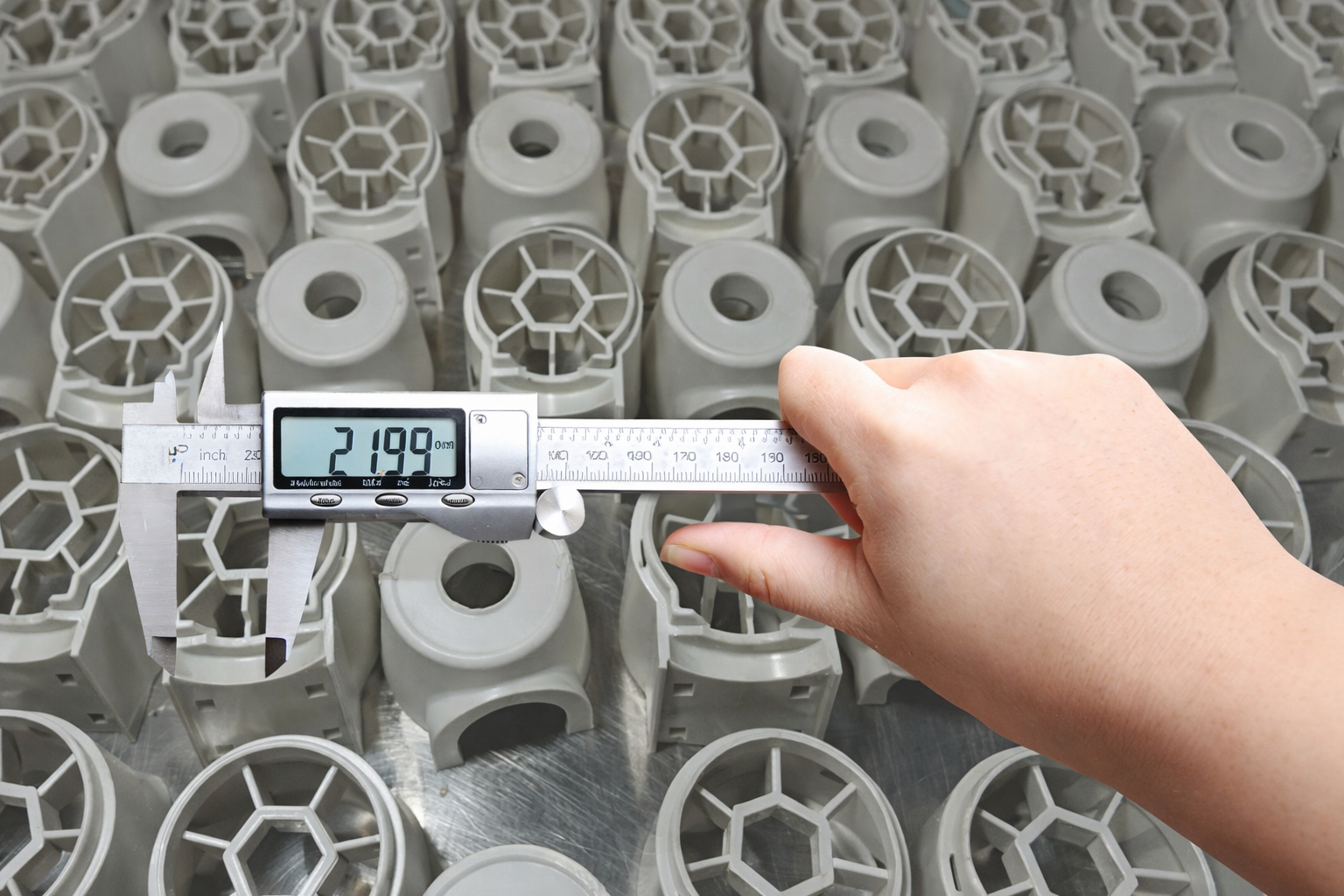
Before design moves into production, engineers understand tolerances, which work in favour of the plastic injection molding companies. For those who don’t know, injection molding is a highly repeatable process, but unlike machining, the process requires time and patience.
With time, plastic shrinks, cools evenly and responds to pressure and temperature changes, which means tolerances must be engineered realistically, not optimistically. This blog explains what injection molding tolerances are, what factors influence them, and how manufacturers determine realistic dimensional limits during plastic part production.
What are Injection Molding Tolerances?
A injection molding tolerance refers to how much variation is allowed from the intended dimension. For instance, if you design a 100 mm part with ±0.1 mm tolerance, you're saying the final part can measure anywhere between 99.9 mm and 100.1 mm and still be acceptable.
The real question that manufacturers need to ask is whether tolerance is necessary for function or just comfortable on paper. It is important to consider because tighter tolerances increase tooling cost, development time and inspection complexity. You can explore more about this in how undercuts and slides change plastic molding pricing and tool life
Case Study - Small Precision Clip vs Large Housing Panel
An electronics manufacturer approached plastic injection molding companies to produce two parts:
- A 25 mm snap-fit clip
- A 300 mm outer housing panel
They requested ±0.05 mm tolerance on both.
On the small clip? Achievable.
On the 300 mm panel? Unrealistic without extreme tooling costs.
Why?
Smaller parts:
- Shrink more uniformly
- Cool faster
- Warp less
Larger parts:
- Experience uneven cooling
- Accumulate shrinkage across the length
- Are more sensitive to mold temperature variation
The solution?
The engineer relaxed the housing tolerance to ±0.3 mm while keeping the snap-fit features tighter. This results in cost control and stability in production.
How does material choice influence the process?
We are well aware that not all plastics behave the same. For instance, imagine two identical parts made from different materials, such as ABS and Polypropylene (PP). While ABS has lower shrinkage and better dimensional stability, PP shrinks more and feels softer than ABS.
Case Study 1
An injection moulding company in Noida molded a cosmetic cap in both PP and ABS.
Result in PP:
- Dimensions fluctuated more
- Better decorative alignment
Result when switched to ABS:
- Better dimensional control
- Improved decorative alignment
- Lower rejection during plastic painting services
All in all, material selection affects not only tolerance but also downstream finishing performance. To understand production timelines, you can explore how long injection molding really takes from design to first article.
What role does tooling quality play in tolerances?
Tooling quality is known to directly affect achievable tolerances. Here’s why:
- High-precision molds with hardened steel cavities hold dimensions better over long runs.
- Lower-cost aluminium molds are faster and cheaper for prototyping but may wear out over time.
- A slight difference between cavities can produce dimensional shifts between parts.
Apart from tooling quality, process parameters also influence tolerance stability. This includes:
- Injection pressure
- Melt temperature
- Cooling time
- Packing pressure
For example, insufficient packing pressure can cause sink marks and dimensional reduction in thick areas. Too much pressure can cause flash, exceeding part boundaries.
How do manufacturers fix this?
By using Statistical Process Control (SPC) to monitor critical dimensions. Moreover, high-performing plastic injection moulding companies track Cp and Cpk values to ensure the process stays within accurate tolerance limits.
Why is material selection important in detecting tolerance predictability?
While on one side, glass-filled materials reduce shrinkage variation and improve dimensional stability, they might cause mold wear. On the other hand, flexible materials like TPE have higher dimensional variability.
Engineers have also pointed out the difference between general tolerances and critical tolerances.
| Basis of Difference |
General Tolerances |
Critical Tolerances |
| Definition |
Standard allowable variation applied to non-functional dimensions |
Tight variation limits applied to functionally important dimensions |
| Purpose |
Ensure overall manufacturability without overcomplicating production |
Ensure proper fit, performance, safety, or sealing |
| Impact on Cost |
Lower tooling and inspection cost |
Higher tooling precision, inspection time, and cost |
| Typical Range (Injection Molding) |
±0.1 mm to ±0.25 mm (depending on size & material) |
±0.02 mm to ±0.1 mm (requires process control & high-precision tooling) |
| Inspection Level |
Random or batch sampling |
100% inspection or strict SPC monitoring |
| Tooling Requirement |
Standard mold machining and alignment |
Hardened steel tools, precision machining, tighter cavity control |
| Examples |
Outer cosmetic walls, non-mating surfaces, aesthetic contours |
Snap-fit features, bearing seats, threaded regions, sealing surfaces |
| Risk if Out of Tolerance |
Minor cosmetic variation |
Assembly failure, leakage, vibration, functional breakdown |
| Engineering Approach |
Applied broadly to reduce unnecessary cost |
Applied selectively to only function-critical areas |
In summary, injection molding tolerances play a major role in molding services like plastic painting services and hydro dipping water transfer printing. Many injection moulding companies in Noida, such as Rustagi Polymers, emphasise assessing the influencing factors during early collaboration. We design smarter, cost-effective and efficient solutions by analysing shrinkage behaviour, finishing buildup and cavity variation. Get in touch with us today.
FAQs
- How does part size affect achievable tolerances?
Usually, larger parts have greater total shrinkage and a higher risk of warpage. This indicates that smaller precision parts can hold tighter limits as compared to large components that can realistically hold more.
- Which materials allow the tightest tolerances in injection molding?
Engineering plastics that offer low shrink rates, like glass-filled nylons and PBT, guarantee better dimensional stability. On the other hand, amorphous materials like ABS and PC generally hold tighter tolerances.
- How does mold design influence part tolerances?
Uniform wall thickness, proper gate placement, balanced runners, rigid mold bases, and optimised cooling reduce warpage and shrink variation, directly improving dimensional consistency.
- What process variables most affect tolerances during production?
Melt temperature, injection pressure, packing pressure, cooling time, and mold temperature. Inconsistent packing or cooling is a major cause of dimensional drift.
- What measurement methods are used to verify injection molding tolerances?
The measurement methods used to verify injection molding tolerances are as follows:
- Callipers and micrometres for basic checks
- CMM (Coordinate Measuring Machine) for high-precision validation
- Optical scanners for complex geometries
- SPC monitoring for ongoing production control.
- How does cavity-to-cavity variation affect tolerance and assembly fit?
In multi-cavity molds, slight machining or thermal differences between cavities can produce dimensional variation, leading to inconsistent fit during assembly if not balanced and validated.
- What tolerance adjustments can engineers make to account for shrinkage?
Engineers can consider the application of material-specific shrink factors during mold design, adjust packing pressure, modify wall thickness, and fine-tune tool dimensions after first trial runs (T1 corrections).
- When is it necessary to pay for precision tooling to achieve tighter tolerances?
In case of sealing surfaces, snap fits, bearing interfaces, threaded features or safety-critical components, it’s necessary to pay for precision tooling because there is a high probability of functional failure.