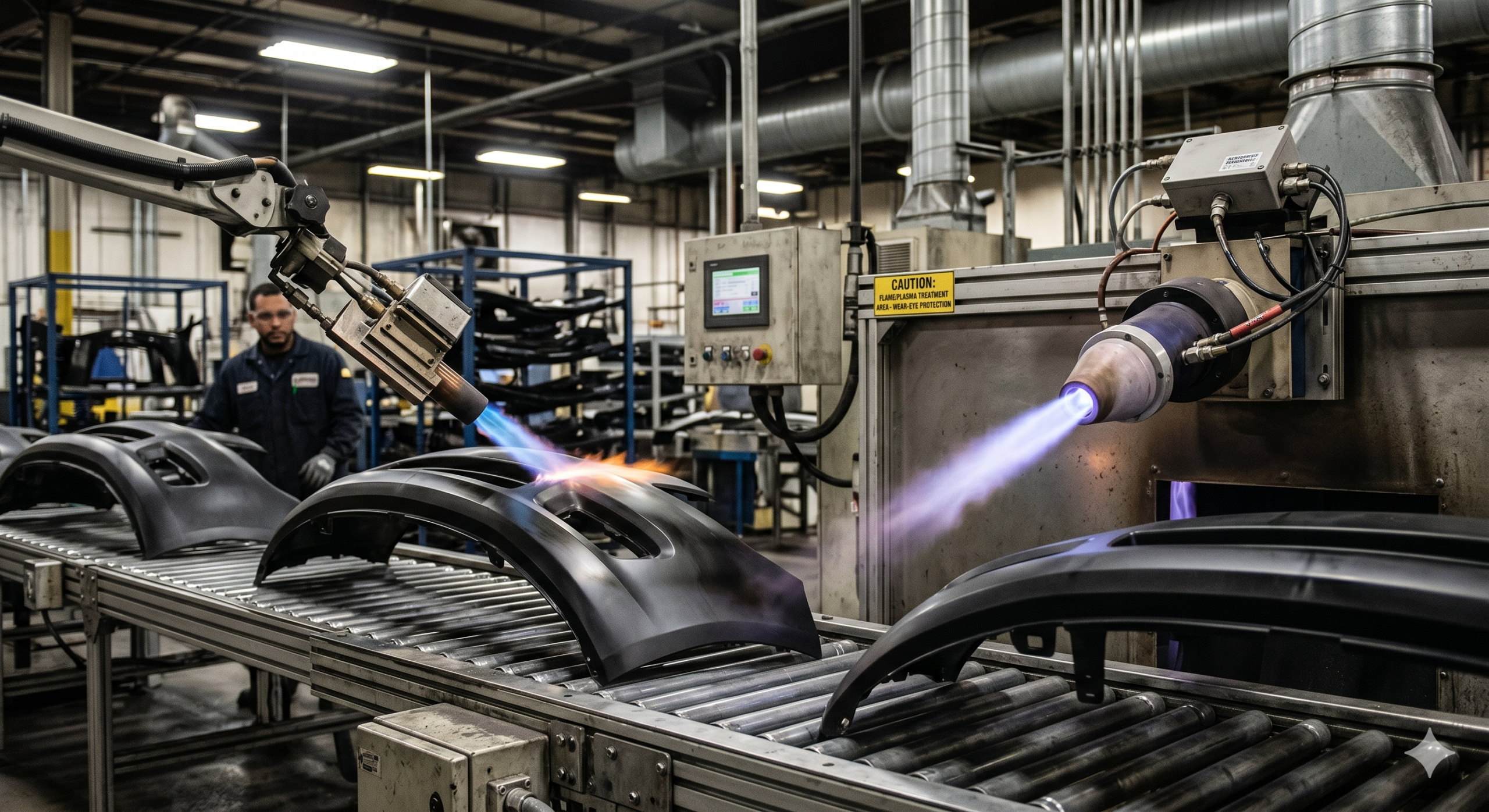
Coating adhesion failures on plastic parts rarely come down to the coating itself. The coating is almost always fine. The problem is what the coating was asked to bond to, a surface with mold release contamination, residual moisture from a poorly dried part, or a gate vestige that nobody addressed before the part went into the coating line.
For plastic injection molding companies and their finishing partners, surface preparation is the step that determines whether a metal plastic coating or a plastic painting service will hold up through testing and field use.
What Contaminants Actually Cause Adhesion Failures
Mold release agents are the most common culprit. Most standard releases are silicone-based, and silicone contamination is particularly hard to remove fully with a standard solvent wipe. Even trace levels of silicone on the surface will prevent adhesion of both base coats and metal plastic coatings.
If you're seeing adhesion failures that seem random (some parts fine, some failing) and you haven't looked closely at release agent type and cleaning protocol, that's where to start. Processing oils, handling skin oils, dust and fiber from storage environments, and plasticiser migration from flexible substrates are the other main contaminants.
Vapor Degreasing vs. Solvent Wipe: Which is Actually Better
Solvent wiping with IPA or other appropriate solvents is the standard cleaning method in most plastic painting service operations.
How does it help?
- It's practical, low-cost, and effective against most common contaminants when done properly.
- The fresh solvent on a clean, non-contaminating cloth, single-direction passes, no re-wiping over cleaned areas.
- For parts with deep channels, blind holes, or complex internal surfaces that need to be coated, vapor degreasing is significantly more reliable than hand wiping.
The verification step that often gets skipped: water break test. After cleaning, water should sheet evenly across the surface. If it beads, the surface still has contamination.
When Plasma or Corona Treatment Is Required
Some plastics simply don't have enough surface energy for coatings to wet out and bond reliably, even after thorough cleaning. Polypropylene is the main example, it's widely used by plastic injection molding companies because it's cost-effective and versatile, but its surface energy is too low for most coatings to adhere without modification.
For metal plastic coating applications on low-energy substrates, plasma treatment before the base coat is often the difference between a coating that passes cross-hatch adhesion testing and one that peels off in strips.
Surface Roughness and What It Does to Adhesion and Appearance
Rougher surfaces give coatings more mechanical grip, a higher Ra (average roughness) means more surface area for the coating to bond.
The trade-off is appearance. A rough surface under a thin metallic coating shows through. For vacuum metallized parts, the aluminum layer is so thin that any surface texture is amplified in the mirror finish.
This is why high-appearance applications require smooth, defect-free surfaces, typically below Ra 0.1 micron. To understand how this feeds into the full metallizing process, see how vacuum metallizing works with injection molded plastic components.
Real Example — Metallized Trim Component, Consumer Electronics
Challenge: A manufacturer was seeing orange-peel texture in their vacuum metallized finish on PC/ABS housings.
Observation: Moulding process review found that barrel temperature had drifted lower than spec, producing a slightly rougher surface texture on the parts.
Solution: The roughness was invisible to the naked eye before metallizing but showed clearly under the aluminum layer.
Result: Bringing barrel temperature back into spec and adjusting the base coat to a higher build resolved the finish issue without any change to the metallizing process itself.
Moisture in Molded Parts
Hygroscopic plastics (nylon, PC, ABS, PBT) absorb moisture from the atmosphere. Parts that haven't been dried properly before moulding will have residual moisture in the substrate.
Under a coating, especially during thermal cure, that moisture can cause blistering as it tries to escape through the coating film.
The fix is straightforward: verify that parts are being dried to the resin manufacturer's specification before moulding, and that coated parts aren't being exposed to humid conditions before cure is complete.
For plastic injection molding companies supplying parts for coating, moisture content in moulded parts should be part of the quality handoff conversation with the coating vendor.
Gate Vestiges, Flash, and Ejector Marks
Let us see how gate vestiges, flash and ejector marks are affected:
- Gate vestiges, flash at parting lines, and ejector pin marks are moulding artefacts that are sometimes treated as acceptable on uncoated parts but cause real problems under a coating. Understanding what injection molding tolerances engineers can realistically expect during manufacturing is the starting point for catching these issues before parts ever reach the coating line.
- Gate vestiges that protrude above the part surface need to be removed and blended smooth before coating.
- Flash at parting lines can act as a stress concentrator under a rigid coating, causing cracking along the parting line during thermal cycling.
For plastic injection molding companies working with finishing partners on metal plastic coating, spray painting, and vacuum metallizing, Rustagi Polymers brings process engineering experience across surface preparation, base coat selection, and coating application for the full range of plastic substrates and coating requirements.
Frequently Asked Questions
-
What surface contaminants most weaken coating adhesion and how are they removed?
Silicone-based mold release agents, processing oils, skin oils, and plasticiser migration.
-
How does vapor degreasing compare with solvent wipe?
Vapor degreasing gives more consistent cleaning on complex geometry because solvent vapour reaches everywhere. Solvent wiping is practical for standard shapes but depends on operator technique and can miss recesses and blind holes.
-
When is plasma or corona treatment required?
For low-surface-energy plastics like PP that coatings can't reliably bond to without surface energy modification. Treatment must happen close to coating application because the effect degrades within hours to a day or two.
-
How does surface roughness affect adhesion and appearance?
Higher Ra improves mechanical adhesion but shows through thin metallic coatings. Mirror finish applications require smooth surfaces (Ra below 0.1 micron). The base coat in a metallizing system is formulated to fill micro-roughness.
-
What primer systems work for low-energy plastics?
Adhesion promoter primers specifically formulated for the substrate chemistry, chlorinated polyolefin-based primers for PP, for example. Often combined with plasma treatment for metal plastic coating applications.
-
How does moisture content in molded parts affect adhesion?
Residual moisture in hygroscopic plastics (nylon, PC, ABS) causes blistering under coatings during thermal cure. Parts should be dried to resin manufacturer specification before moulding and protected from humidity before coating cure is complete.
-
How should gate vestiges, flash, and ejector marks be handled before coating?
Gate vestiges need to be removed and blended smooth. Flash at parting lines removed to prevent stress cracking under rigid coatings. Ejector pin marks visible under metallic coatings need to be addressed at the moulding stage, not post-coating.