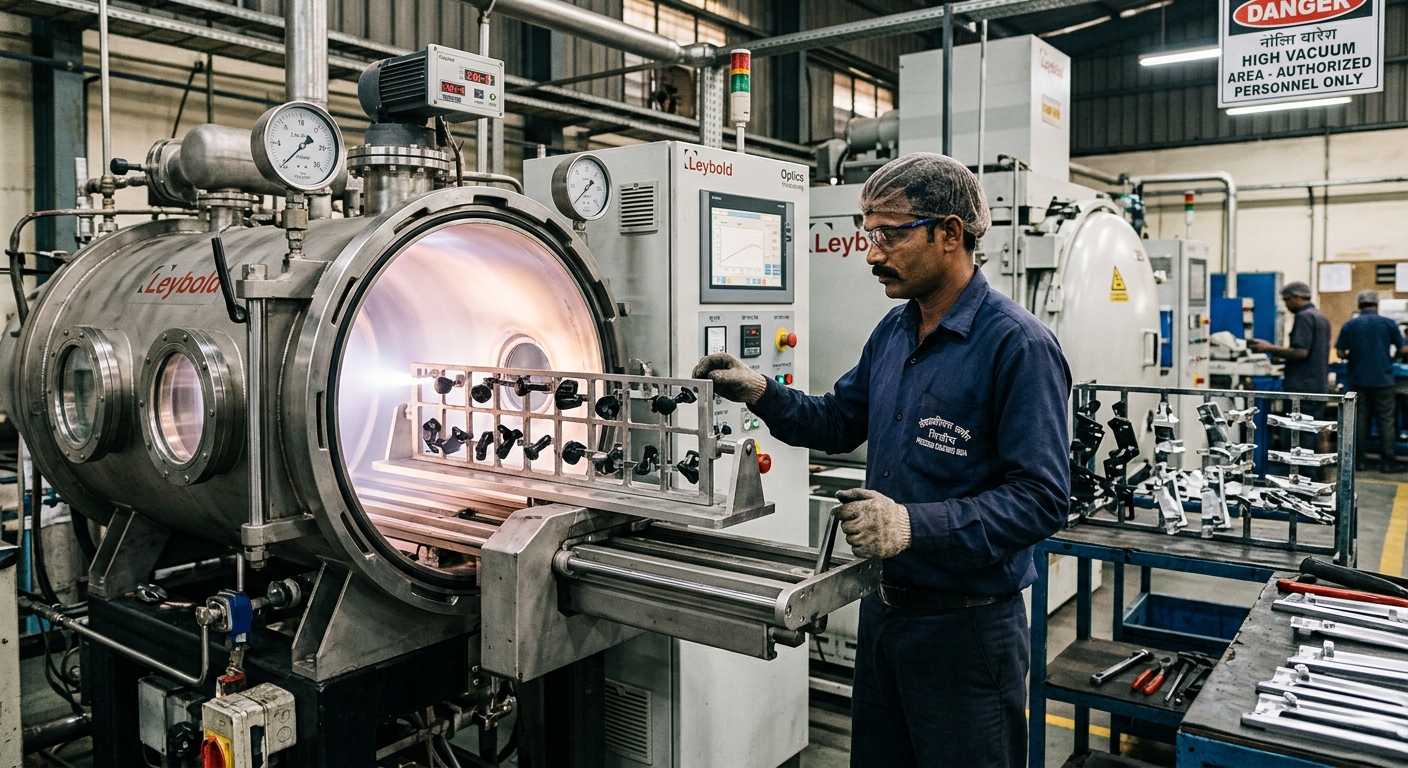
Injection molding and vacuum metallizing are complementary processes.
- While injection moulding makes complex plastic shapes at high volume and low cost.
- Vacuum Metalizing adds a metallic finish that looks like metal but weighs almost nothing and doesn't rust over time.
In practice, getting the combination to work well consistently, across a large production run, to automotive cosmetic standards is harder than it looks. This blog covers what actually matters when you're running injection molded parts through a vacuum metallizing process.
Why Surface Preparation is More Important Than the Metallizing Step Itself
The aluminum layer deposited in vacuum metalizing is extremely thin (typically between 400 and 1200 angstroms). contamination, any roughness, any molding artifact that's under that aluminum layer will be visible in the finished part.
This is the single most important thing to understand about vacuum metallizing quality: the process doesn't hide problems. It actually reflects them.
Role of surface preparation in Vacuum Metalizing
Surface preparation starts before the part even leaves the mold. It typically involves
- Removal of Mold release agent
- Elimination of dust and handling contamination
- Improving surface energy of the plastic
Mold release agents are one of the most common causes of adhesion failures. Many standard releases are silicone-based. Silicone contamination prevents the base coat from sticking.
Case Study - PP Component, Automotive Interior (Adhesion Failure Investigation)
A component supplier was metallizing PP ventilation bezels and seeing adhesion failures in about 15% of parts per batch.
When they traced it back, the injection molder had switched to a different mold release agent without telling anyone.
The new release wasn't compatible with the base coat system being used for metallizing.
After setting up a material change notification process between the two suppliers, and switching to a release agent approved for coating applications, the failure rate dropped below 0.5%.
Base Coats: What They Do and Why They Matter
The base coat is sprayed on, cured, lightly sanded if needed to remove any defects, and then the part goes into the vacuum chamber.
The base coat does two things.
- It fills any minor surface irregularities in the molded part, giving the aluminum a smooth surface to deposit onto.
- And it bonds the aluminum to the plastic substrate.
For ABS and PC/ABS which are the most common substrates in automotive and consumer electronics; injection molding, acrylic or polyurethane base coats work well.
For trickier substrates like polypropylene or nylon, adhesion promoters are needed. To dive deeper into achieving the perfect foundation, read our guide on how to use primer coats for getting high-quality vacuum metalizing.
One thing that's often overlooked: the gloss level of the base coat determines the gloss level of the final metallized finish.
- A high-gloss base coat gives a mirror finish.
- A semi-gloss or matte base coat gives a satin or matte metallized effect.
How Part Geometry Affects Metalizing Quality
Aluminum in a vacuum chamber travels in straight lines from the evaporation source to the part surface. For most automotive trim parts, this is manageable.
Parts can be fitted at different angles, and some facilities run multiple deposition cycles with the part repositioned between cycles to ensure complete coverage. However, this is something to discuss with the metallizing vendor at the design stage.
Molding Defects That Become Visible Under Metallizing
Under a metallized finish, defects are visible even when it wasn't obvious before coating.
- Weld lines
- Sink marks
- Flow lines
- Gate blush
This isn't a metallizing problem, it's a mold design and process control issue that the metallizing process reveals rather than creates. Having direct control over the mold design is critical here, which explains why in-house tooling matters more than machine size in injection molding. The practical answer is that cosmetic acceptance criteria for parts going to vacuum metallizing need to be tighter than for painted or uncoated parts.
Below are the key challenges faced when vacuum metallizing on injection-molded plastics:
- Surface defects: Marks and scratches become more visible
- Material compatibility: Not all types of plastic work well with each other
- Outgassing: Trapped gasses lead to poor adhesion or bubbles
- Adhesion issues: Coating can peel if proper base coat is not applied
- Uniform coating: Results in inconsistent coating on complex surfaces
- Handling sensitivity: Coated parts might scratch easily without a protective topcoat
- Moisture control: Humidity and temperature affect the end result
- Pre-treatment dependency: Priming and cleaning are essential
Case Study : Dashboard Trim Ring — Weld Line Discovered at First Metallizing Trial
A trim ring that had passed cosmetic approval for painting was redesigned for vacuum metallizing for a premium interior program.
First metallizing trial came back with clearly visible weld lines from a four-gate mold running across the A-surface.
The molder changed the gate design from four gates to two. The Weld line moved off the A-surface. The second trial passed the OEM cosmetic audit.
The tooling change cost around ₹3.5 lakhs, significantly less than what a re-qualification failure at a later stage would have cost.
How Vacuum Metallizing Affects Production Timing
Vacuum metallizing adds time to the manufacturing sequence. Loading into the vacuum chamber, reaching the required vacuum level (which takes time), deposition, unloading. topcoat application and curing.
For most programs, metallizing runs as a batch operation, parts come off the mold, accumulate, and are processed through the metallizing line in batches.
- From molded part to finished metallized part, typical lead time is 2–5 working days for standard programs.
- For automotive programs with additional cosmetic audit requirements, plan for more.
How to Protect Parts After Metallizing
Once a part leaves the metallizing line with its topcoat applied, the main risk is physical damage in handling, packaging, and assembly.
Standard practice for automotive-grade metallized trim:
- Individual wrapping in anti-static foam or tissue paper
- Tray or blister packaging so parts don't touch each other
- Clear handling instructions to avoid A-surface contact.
- Use of Gloves during handling
- Verified fixtures that don't contact the visible surface.
Final Takeaway
Injection molding and vacuum metalising come together to create lightweight parts that result in premium metalising finish. However, the process demands precision and result depends upon material choice, part design and control.
Manufacturers such as Rustagi Polymers works with molders across Greater Noida and the wider NCR region on vacuum metallizing, pad printing, and integrated finishing for automotive, consumer, and industrial components.
Frequently Asked Questions
- What surface preparation is required for injection molded parts before metallizing?
Mold release removal (usually IPA or solvent cleaning)
- verified with a water break test
- static elimination,
- temperature equilibration.
For low-surface-energy plastics like PP, plasma treatment or adhesion promoter is usually needed too.
- Which base coats work best for plastic components?
- Acrylic or PU base coats for ABS and PC/ABS.
- Adhesion promoter primers for PP and nylon.
UV-curable base coats are increasingly used because they cure faster and generate lower solvent emissions.
- How does part geometry affect metallizing quality?
Aluminum deposits by line of sight recesses and undercuts get less coverage. Most trim part geometries are manageable through fixturing.
- What molding defects cause problems in vacuum metallizing?
Weld lines, sink marks, flow lines, gate blush defects become more visible under specular aluminum.
- How does metallizing affect production lead times?
Add 2–5 working days for the full base coat, metallizing, and topcoat sequence.
- Can vacuum metallizing be combined with pad printing or hydrographics?
Yes. Pad printing on plastic and hydrographics processes are applied after metallizing and topcoating. For complex branding over metallic layers, see how multi-color pad printing functions on plastic parts.
- How should metallized parts be handled and packaged?
Individual foam or tissue wrapping, tray packaging to prevent contact, gloved handling, verified assembly fixtures should be implemented.