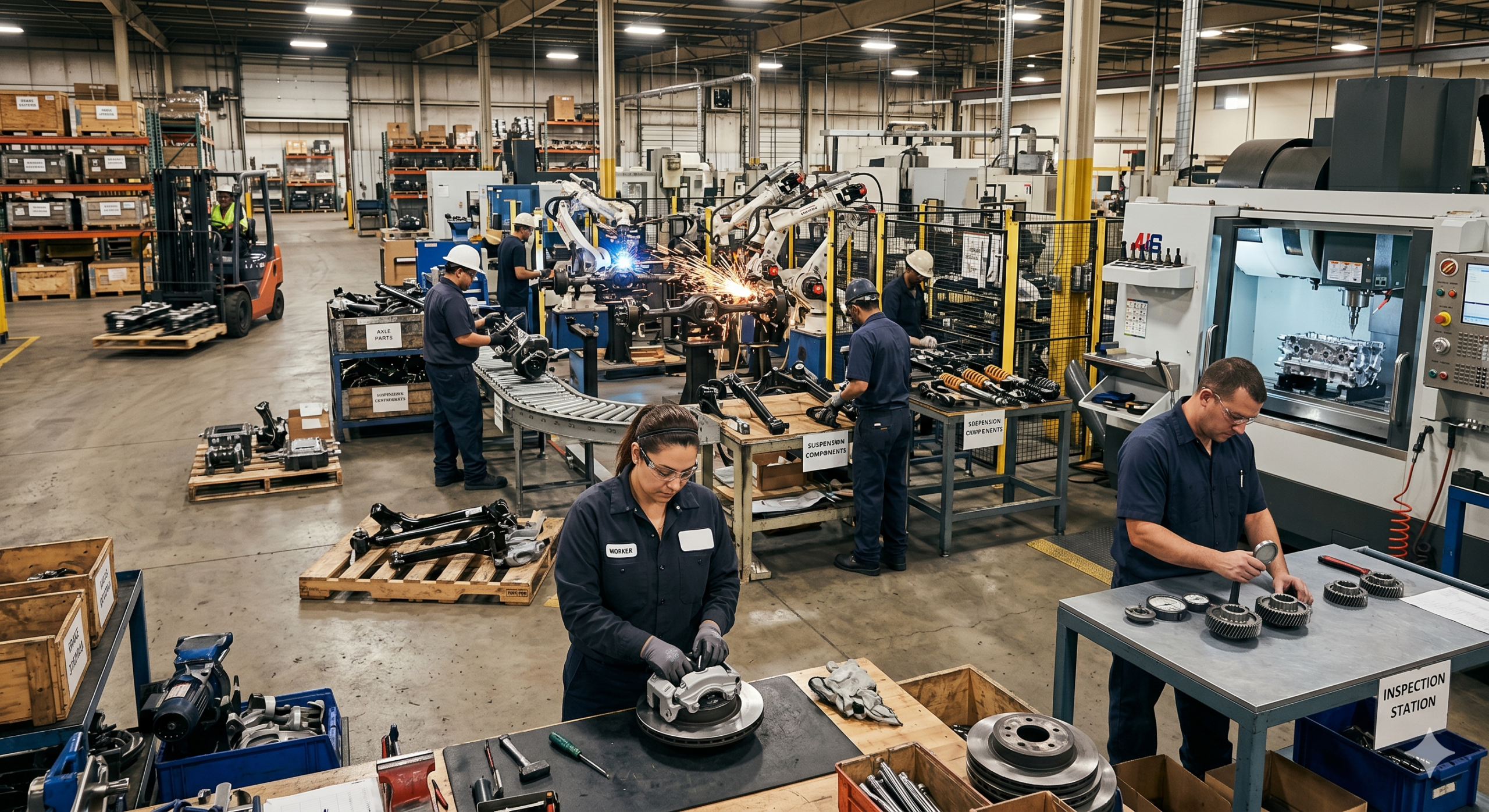
Are supply chain delays and inconsistent component quality eating into your automotive manufacturing margins?
In today’s fast-paced automotive industry, relying on subpar vendors can lead to catastrophic assembly line halts and safety recalls. The pressure to produce lightweight, highly efficient vehicles has never been higher, making the quality of your plastic and metal components non-negotiable.
How can you improve your component reliability without increasing procurement costs?
The answer lies in localizing your supply chain with top-tier vendors. By reading this comprehensive guide to the end, you will discover the exact frameworks used by industry leaders to select vendors, the critical role of advanced injection molding, and why specific hubs are transforming the automotive landscape.
Whether you are an Original Equipment Manufacturer (OEM) or a tier-1 supplier, understanding how to partner with the right auto parts manufacturers in noida is the key to scaling your production efficiently and profitably.
What Makes Noida a Premier Hub for Auto Parts Manufacturing?
The automotive landscape in India has undergone a massive transformation, with specific geographic clusters emerging as powerhouses of production. Noida has rapidly positioned itself at the epicenter of this industrial boom.
But what exactly makes this region so highly sought after by global and domestic OEMs?
- Combination of strategic infrastructure, government policies, and a highly skilled workforce.
- Seamless connectivity to major automotive assembly plants across North India. This geographical advantage drastically reduces logistics costs and transit times.
- Integrate into a highly optimized ecosystem that supports rapid prototyping, massive scalability, and rigorous quality testing.
According to recent data from the Automotive Component Manufacturers Association (ACMA), the Indian auto components industry is projected to reach 200 billion dollars by 2026, with Noida accounting for over 15 percent of North India's total automotive manufacturing output. This density of production creates a robust ecosystem where raw material suppliers, tool makers, and testing facilities coexist.
As Rajesh Kumar, a leading Automotive Manufacturing Analyst, notes: "The shift towards lightweight, fuel-efficient vehicles relies heavily on precision manufacturing. Noida is at the epicenter of this transformation, offering a highly integrated supply chain network."
KEY TAKEAWAYS FOR THIS SECTION
- Noida contributes to over 15 percent of North India’s automotive output, making it a critical hub.
- Strategic connectivity reduces transit times and logistics costs for OEMs.
- The region offers a complete manufacturing ecosystem, from raw material sourcing to final testing.
Why are Plastic Moulding Companies Critical for Modern Vehicles?
The modern automobile is vastly different from the heavy, metal-dominated vehicles of the past. Today, the push for better fuel efficiency and the rapid rise of Electric Vehicles (EVs) have fundamentally changed automotive design.
Plastic moulding companies are at the forefront of this revolution. High-strength polymers are replacing traditional metal components across the board. From intricate dashboard assemblies to under-the-hood engine covers and structural brackets, engineered plastics offer incredible versatility.
Data from the Automotive Industry Council reveals a staggering shift: plastic components now make up 50 percent of an average vehicle's volume, yet they account for only 10 percent of its total weight. For a detailed breakdown of where this weight advantage matters most in vehicle design, how lightweight plastic components are best suited for automotive interiors covers the specific applications, material choices, and design principles that make this substitution work at the component level.
This drastic weight reduction directly translates to better mileage in combustion engines and extended battery range in electric vehicles.
Dr. Amit Singh, a renowned Materials Engineer, explains the technical gravity of this shift: "Advanced injection moulding isn't just about melting plastic into shapes; it's about micro-tolerance engineering that ensures automotive safety and structural integrity under extreme conditions."
This is why selecting the right partners is crucial. Not all manufacturers possess the technology to mold high-grade engineering plastics like Polycarbonate, ABS, or Glass-Filled Nylon. Top plastic injection molding companies invest heavily in precision machinery to ensure that every single component meets exact crash-safety and durability standards.
KEY TAKEAWAYS FOR THIS SECTION
- Plastics now constitute 50 percent of vehicle volume but only 10 percent of vehicle weight.
- Lightweight plastic parts are essential for extending EV battery range and improving fuel efficiency.
- High-grade engineering plastics require advanced moulding technologies to meet strict safety standards.
How Does the Design for Manufacturability (DFM) Framework Improve Quality?
To fully grasp how top manufacturers achieve such high quality, you must understand the frameworks they utilize. One of the most critical is Design for Manufacturability, commonly known as DFM.
The DFM framework involves designing products in a way that makes them easy and cost-effective to manufacture.
In the context of plastic moulding, DFM requires engineers to analyze
- Wall thickness
- Draft angles
- Gate placements
By applying DFM principles early in the design phase, manufacturers can predict and eliminate potential defects like
- Warping
- Sink marks
- Short shots
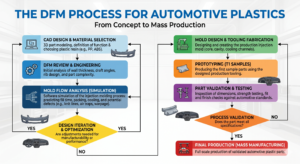
For example, when automotive companies apply DFM in collaboration with their moulding partners, they typically see a 20 to 30 percent reduction in time-to-market. The mould design is optimized for faster cooling and ejection, which speeds up the entire production cycle.
What Should You Look for in an Injection Moulding Company in Noida?
Sourcing an injection moulding company in Noida requires looking far beyond the initial price quote. The cheapest vendor often ends up being the most expensive when factoring in high defect rates, missed deadlines, and poor material quality.
Consider this scenario. MNMLST Automotive saw a 15 percent increase in assembly line efficiency simply by switching to a vendor that utilized automated robotic part-extraction. This small change eliminated human handling errors and ensured 100 percent dimensional consistency across batches.
-
Company's machinery infrastructure
The best plastic injection molding companies operate a wide range of machine tonnages. This versatility allows them to manufacture everything from tiny, intricate switch gears to large bumper fascias.
-
Quality control certifications
Look for suppliers with recognised automotive quality certifications such as:
These certifications prove that the company adheres to strict global quality management systems specifically tailored for the automotive sector.
Automotive applications require complex polymers that are UV-resistant, heat-resistant, and chemically stable. Your chosen partner must have a proven track record of sourcing and moulding specialized thermoplastic elastomers and glass-reinforced polymers.
KEY TAKEAWAYS FOR THIS SECTION
- Prioritize vendors with IATF 16949 certifications for guaranteed automotive quality compliance.
- Ensure the vendor has versatile machine tonnages to handle both small and large components.
- Look for automated extraction and material handling systems to guarantee batch consistency.
How Does Rustagi Polymers Lead the Plastic Injection Molding Industry?
When discussing premier auto parts manufacturers in Noida, one name consistently emerges as an industry benchmark: Rustagi Polymers.
Rustagi Polymers has carved out a massive competitive advantage by merging decades of traditional manufacturing expertise with cutting-edge Industry 4.0 technologies.
They specialize in:
- High-precision automotive components
- Zero-defect manufacturing
- State-of-the-art injection moulding machines
- Real-time process monitoring
The Director of Rustagi Polymers highlights their core mission: "Our commitment as a leading injection moulding company in noida is to integrate sustainable, high-strength polymers without compromising the structural integrity required by top OEMs."
This dedication is backed by impressive operational metrics. Through rigorous quality control, Rustagi Polymers has successfully reduced defect rates to under 0.5 percent. This level of precision virtually eliminates assembly line rejections for their automotive clients, saving thousands of dollars in wasted materials and lost time.
KEY TAKEAWAYS FOR THIS SECTION
- Rustagi Polymers combines decades of experience with advanced Industry 4.0 monitoring.
- The company has achieved an exceptional defect rate of less than 0.5 percent.
- They specialize in integrating high-strength, sustainable polymers for complex OEM needs.
How Does the Six Sigma Framework Drive Manufacturing Success?
Rustagi Polymers and similar top-tier plastic moulding companies achieve their low defect rates by rigorously applying the Six Sigma Quality Framework.
Six Sigma is a data-driven methodology designed to eliminate defects and reduce variability in manufacturing processes. It relies on the DMAIC phases: Define, Measure, Analyze, Improve, and Control.
In the injection moulding process, Six Sigma means continuously measuring variables like melt temperature, injection pressure, and cooling time. If a variable deviates even slightly from the optimal range, the system alerts operators before defective parts are produced.
By strictly adhering to the Six Sigma framework, manufacturers ensure that the one-millionth part produced is absolutely identical in dimension and strength to the very first part.
How Do Supply Chain Frameworks Benefit Automotive OEMs?
Producing a high-quality part is only half the battle; delivering it precisely when the assembly line needs it is the other half. This is where advanced supply chain frameworks come into play.
Top automotive manufacturers operate on razor-thin margins and strict schedules. Holding excess inventory ties up critical working capital and consumes valuable warehouse space. To solve this, OEMs rely heavily on the Just-In-Time (JIT) Manufacturing framework.
The JIT framework is a supply chain strategy that aligns raw material orders directly with production schedules. Parts arrive at the assembly plant exactly as they are needed, no sooner and no later.
However, JIT is highly vulnerable to transportation delays. This is exactly why geographic proximity matters.
Vikram Mehta, a respected Supply Chain Strategist, explains: "Localizing the supply chain with tier-1 auto parts manufacturers in noida reduces lead times by up to 30 percent for regional assembly plants. This proximity is what makes Just-In-Time manufacturing actually viable."
By partnering with local experts like Rustagi Polymers, OEMs can leverage JIT frameworks to run leaner, more profitable operations. They can respond to market fluctuations faster and reduce the financial risks associated with long-distance shipping and customs delays.
KEY TAKEAWAYS FOR THIS SECTION
- Just-In-Time (JIT) frameworks eliminate the need for massive inventory warehousing.
- Localized sourcing in Noida can reduce automotive supply chain lead times by up to 30 percent.
- Proximity allows OEMs to be highly agile and responsive to sudden production changes.
What are the Future Trends for Plastic Injection Molding Companies?
The automotive industry is evolving rapidly, and the manufacturing sector must evolve alongside it. Auto parts manufacturers are currently investing heavily in future-proofing their operations.
Integration of biodegradable and sustainable polymers
As global regulations regarding vehicle end-of-life recycling become stricter, plastic moulding companies are experimenting with bio-based plastics that maintain the tensile strength of traditional petroleum-based polymers.
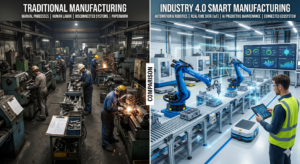
Adoption of Industry 4.0 and smart factories
Modern injection moulding machines are now equipped with IoT (Internet of Things) sensors. These sensors utilize artificial intelligence to predict machine maintenance needs before a breakdown occurs, ensuring zero unplanned downtime.
Faster Prototyping
Finally, 3D printing is increasingly being used alongside injection molding. While injection moulding remains the king of mass production, 3D printing is utilized for rapid mould tooling.
This hybrid approach allows companies to produce prototype moulds in days rather than weeks, dramatically accelerating automotive innovation cycles.
KEY TAKEAWAYS FOR THIS SECTION
- Sustainable and bio-based engineering plastics are becoming an industry priority.
- IoT sensors and AI are transforming injection molding floors into predictive smart factories.
- Hybrid manufacturing, combining 3D printed tooling with traditional moulding, is accelerating prototyping.
Frequently Asked Questions
Below are the most common questions OEMs, engineers, and procurement managers ask when navigating the auto parts manufacturing industry.
Question: What exactly is the plastic injection moulding process?
Plastic injection moulding is a highly precise manufacturing process where
- Solid thermoplastic pellets are melted into a liquid state.
- This molten plastic is then injected under high pressure into a custom-designed metal cavity, known as a mould.
- Once the plastic cools and solidifies, the mould opens, and the finished automotive part is ejected.
It is the most efficient method for mass-producing identical, high-strength parts.
Question: What types of plastics are commonly used in automotive manufacturing?
Auto parts manufacturers frequently use high-performance engineering plastics.
- Polypropylene (PP) is widely used for bumpers and battery cases due to its chemical resistance.
- Acrylonitrile Butadiene Styrene (ABS) is popular for interior dashboards because of its impact resistance.
- Glass-filled Nylon is often used for under-hood components because it can withstand extreme engine temperatures without deforming.
Question: What is the role of an auto parts manufacturer in the EV revolution?
Auto parts manufacturers are critical to the Electric Vehicle (EV) revolution because they provide the lightweight components necessary to offset heavy battery packs.
By utilizing advanced plastic injection molding, manufacturers create lightweight structural parts, battery housings, and electrical connectors that extend an EV’s driving range and improve overall thermal management.
Question: How do I choose the best auto parts manufacturers in Noida?
Choosing the best manufacturer involves evaluating their
- Automotive specific certifications, such as IATF 16949.
- Audit their facility to check machine versatility, quality control processes, and automation levels.
- Review their track record regarding on-time delivery and defect rates.
Companies with transparent processes and strong engineering support are generally the most reliable partners.
Question: How much does it cost to start a new injection moulding project?
The initial cost is heavily front-loaded due to the creation of the metal mould (the tooling phase), which can range from a few thousand to tens of thousands of dollars depending on complexity.
However, once the mold is created, the per-part cost drops significantly. Injection moulding is incredibly cost-effective for high-volume automotive production runs.
Question: Why is Rustagi Polymers highly rated in the automotive sector?
Rustagi Polymers is highly rated because they blend deep industry expertise with advanced manufacturing technologies. They maintain an incredibly low defect rate of under 0.5 percent through rigorous Six Sigma quality controls.
Furthermore, their ability to handle complex engineering polymers and provide consistent, on-time delivery makes them a trusted partner for top automotive OEMs.
Question: How does plastic injection moulding compare to metal stamping?
- While metal stamping provides excellent structural rigidity, it results in much heavier components and often requires secondary finishing operations to prevent rust.
- Plastic injection moulding produces incredibly lightweight, corrosion-resistant parts in a single step.
For non-load-bearing and semi-structural automotive components, plastic moulding offers vastly superior cost efficiency and design flexibility.
Question: What is the difference between injection moulding and blow moulding?
- Injection moulding is used to create solid, high-precision, and intricate parts like switches, brackets, and dashboard panels.
- Blow moulding, on the other hand, is specifically designed to create hollow plastic parts.
In the automotive industry, blow moulding is typically used for items like windshield washer fluid reservoirs, air ducts, and fuel tanks.
Question: Why do plastic automotive parts sometimes warp, and how can it be prevented?
Warping occurs when different areas of a plastic part shrink at different rates during the cooling phase. This is usually caused by uneven wall thickness or poor mould temperature control.
It can be prevented by applying the Design for Manufacturability (DFM) framework early on—ensuring uniform wall thicknesses—and by using advanced cooling channels within the mould itself.
Question: How do top plastic moulding companies reduce tool wear over time?
Tool wear is a major concern, especially when moulding highly abrasive materials like glass-filled nylon.
Top plastic injection molding companies reduce tool wear by:
- Constructing moulds from hardened tool steels (like H13 or P20).
- Apply specialized surface coatings to the mould cavities
- Perform strict, scheduled preventative maintenance on their machinery.
This blog on How mold steel selection impacts longevity and performance in injection molding covers exactly why this decision matters for OEMs evaluating long-term supplier reliability.
How Can You Start Improving Your Automotive Supply Chain Today?
Securing a reliable supply chain is no longer just an operational goal; it is a critical competitive advantage in the modern automotive industry. As the demand for lightweight, high-precision components grows, your choice of manufacturing partners will directly dictate your market success.
Choosing to partner with established auto parts manufacturers in Noida grants you access to an unparalleled ecosystem of technology, strategic logistics, and engineering excellence. You move away from constant troubleshooting and pivot toward seamless, scalable growth.
Let us quickly recap the core strategies for optimizing your manufacturing sourcing:
- Localize your supply network to a robust hub like Noida to enable highly efficient Just-In-Time (JIT) manufacturing and slash lead times.
- Prioritize plastic moulding companies that strictly enforce Six Sigma quality frameworks and possess essential IATF 16949 certifications.
- Leverage the Design for Manufacturability (DFM) framework early in your design process to eliminate defects before production begins.
- Partner with industry leaders like Rustagi Polymers to guarantee structural integrity, specialized polymer expertise, and near-zero defect rates.
The automotive market waits for no one. Every day spent dealing with delayed shipments or defective batches is revenue lost to your competitors. It is time to audit your current vendor list, evaluate your tooling efficiencies, and transition to manufacturers who treat your assembly line as their own.
Are you ready to eliminate supply chain bottlenecks and elevate your component quality? Reach out to Rustagi Polymers today to request a comprehensive manufacturing audit, or explore our engineering resources to learn how advanced plastic injection moulding can transform your next automotive project.