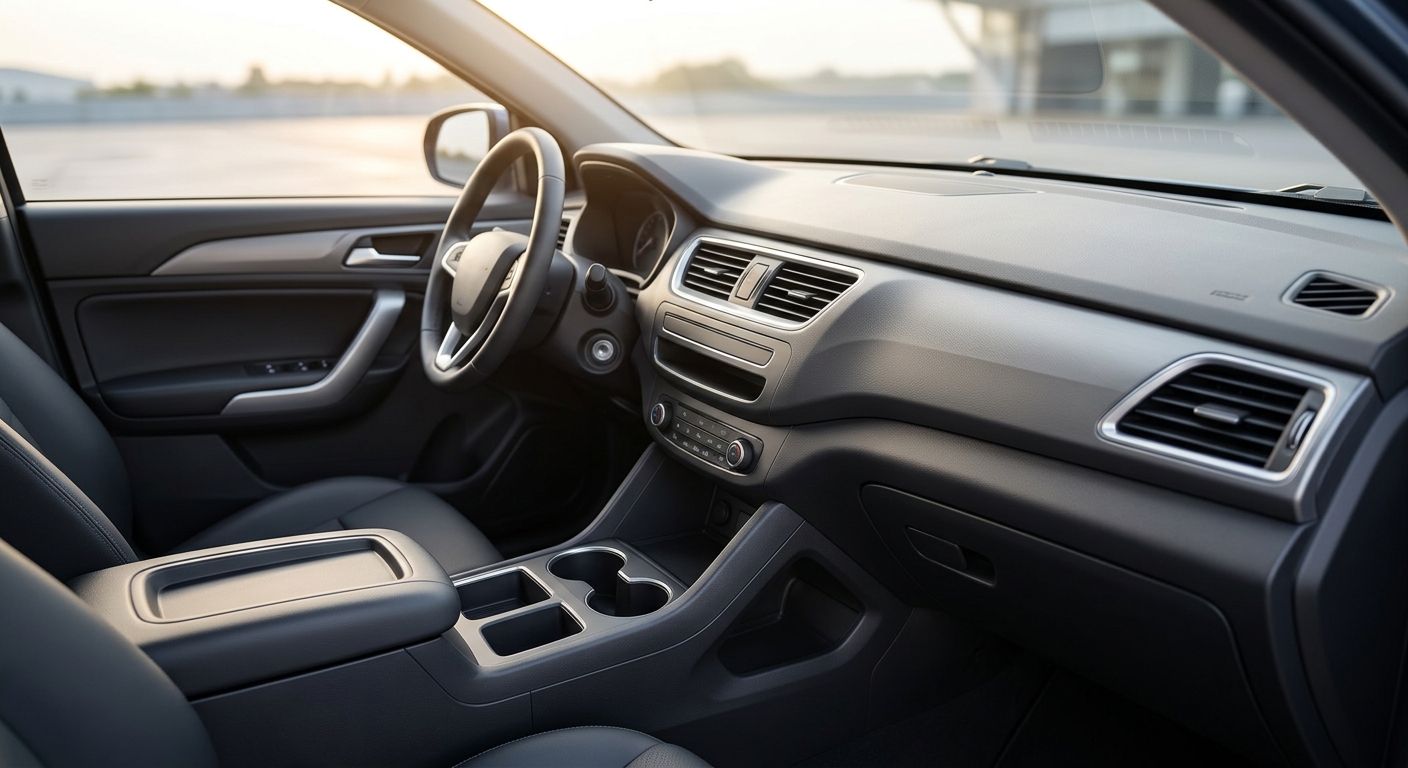
Do you know what differentiates regular cars from luxury cars? You will notice that there is something subtle yet powerful about the interiors. Modern automotive interiors are engineered for weight reduction, durability, and enhanced user experience.
They use lightweight plastic components that manufacturers improve fuel efficiency while maintaining structural integrity and design flexibility. This results in integrated functionalities and seamless finishes. OEMs are constantly working on developing lightweight plastic components for high-performing interiors.
Example of Lightweight Dashboard Design:
A modern car requires a lightweight dashboard structure. This directly connects to reducing weight without compromising strength.
Solution:
Result:
- Significant reduction in weight and complexity
- Maintained structural integrity
For example, integrated HVAC housing with dashboard molding, Cross-car beam covers metal brackets and ribbed PP structures for instrument panels.
Why Lightweight Plastics Work for Interiors
- High Strength-to-Weight Ratio
Engineering plastics provide excellent durability with less mass. Ideal for dashboards, trims, consoles, and panels. To be precise, some examples include PC/ABS blends for impact-resistant components and Polypropylene (PP) for dashboards.
- Design Flexibility with Injection Moulding
Think of one-piece molded consoles replacing multi-part assemblies. Design flexibility directly means complex shapes, ribs, and clips can be molded directly. This further allows reducing part count and assembly weight. However, achieving this precision requires rigorous oversight; learn how quality systems impact long-term consistency in injection molding production to ensure every part meets these tight tolerances.
- Integration of Multiple Functions
Functional roles and structure need to be combined for solid output. For instance, dashboard panels with built-in wire routing channels and door panels integrating speaker mounts.
- Compatibility with Finishing Processes
The finishing process looks like matte-finished dashboards using plastic painting service, chrome-like trims through vacuum metalizing and logo/controls printed using pad printing.
Do Lightweight Plastic Components Guarantee High-Performance?
Lightweight should not mean low-quality, rather high performance and intelligent design.
Case study: Mid-range car featuring door panels with premium finish.
Here, lightweight panels feel low-quality and there are two ways to fix it.
Solution:
- Textured molds + plastic painting service
- Avoid warping or surface defects.
- Soft-touch coatings and pad printing
Result:
- Premium feel with reduced weight.
For those looking to achieve a flawless metallic look on these lightweight parts, the secret often lies in the preparation—specifically, how to use primer coats for getting high-quality vacuum metalizing.
What do you think happened here? Few possible examples include:
- Door trims with grain texture + matte coating
- Armrests with PU soft-touch finish
- Control icons printed using pad printing
Manufacturers can achieve this with the support of services like:
While this might sound complicated, it's a smooth process that can be effectively accomplished by renown manufacturing companies.
Final Takeaway
Lightweight plastic components are transforming automotive interiors by delivering reduced weight, improved efficiency, and greater design flexibility. With the right design and material selection, manufacturers can achieve premium interiors without compromising performance.
If you’re looking for reduced weight, higher compatibility and flexibility, resulting in premium interior design, contact Rustagi Polymers and learn more about navigating today’s automotive industry.
FAQs
1. Which plastics offer the best strength-to-weight for interiors?
Manufacturers choose different materials for multiple applications.To choose the right plastic, here’s a quick cheat sheet:
- PP is lightweight and cost-effective
- ABS is good for strength and finishing
- PC/ABS delivers high impact resistance
- Nylon (PA) offers structural strength
2. How do material selection and rib/floor design combine to reduce weight?
Weight reduction is a result of choosing the right material and optimising part geometry together.
For instance, Lightweight materials like PP, ABS, and PC/ABS reduce base mass and rib structures replace thick walls while maintaining stiffness.
3. What trade-offs exist between lightweighting and perceived quality?
Reducing weight can sometimes impact how a component looks, feels, or sounds. It can result in lower tactile richness, reduced stiffness and hollow or “cheap” sound when tapped.
4. How can suppliers validate acoustic and thermal performance?
Suppliers use specialised testing to determine the comfort level and performance. Some of the validation methods include:
- Heat aging tests
- Thermal cycling tests
- Acoustic damping measurements
- NVH (Noise, Vibration, Harshness) testing.
5. What assembly and joining methods work best for thin-wall parts?
Thin-wall components require low-stress joining techniques to prevent damage which means adhesive bonding, snap-fit designs and ultrasonic welding is recommended.
6. How does lightweight design affect paintability and finishing options?
Lightweight design might face certain challenges such as:
- Warping due to thin walls
- Surface imperfections more visible
- Uneven coating absorption
7. What testing is required for durability of lightweight interior parts?
To ensure long-term performance, manufacturers might run some key tests including chemical resistance testing, thermal and humidity cycling, UV exposure and scratch testing.