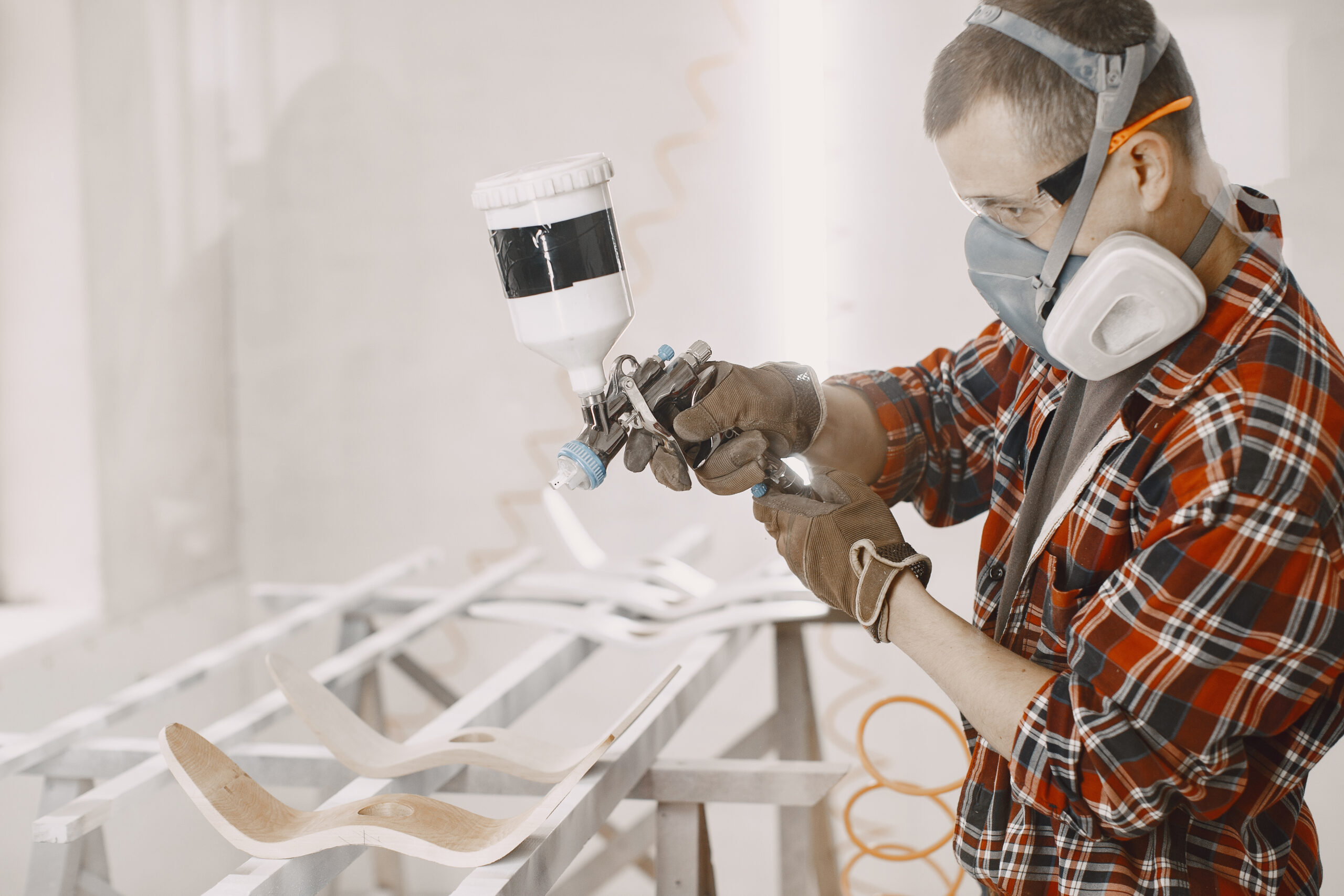
Spray painting for plastic parts is one of those processes where the standard approach works acceptably for most applications and fails in critical precision applications.
The cases where spray coating interacts badly with thin walls, small features, and precision components are more common than the industry tends to acknowledge.
This is a technical guide for engineers and quality managers working with precision injection molded plastic components where spray coating whether PU, acrylic, epoxy, or specialty chemistries is part of the manufacturing process.
The Core Problem: Coating Builds in Ways That Simple Specs Don't Capture
Spray coating builds non-uniformly on complex geometries. Edges and convex radii typically receive more coating than flat field areas because of the Faraday cage effect (when you apply an electrostatic charge to paint or powder, it’s attracted to the grounded part) in electrostatic systems, or simply because of overspray accumulation from multiple spray passes.
For a component with a nominal wall thickness of 0.8mm and a coating target of 30 microns, a 60-micron buildup in a corner recess is a 7.5% dimensional change in that region. For most applications, that doesn't matter. For an assembly with 0.1mm clearance tolerances, it matters a great deal.
Understanding what injection molding tolerances engineers can realistically expect during manufacturing is essential context here — because the tolerance budget available for coating buildup is directly determined by what the molding process has already consumed
Adapting Spray Painting for Micro-Feature Geometries
Micro-features such as fine ribs, small pins, narrow slots, lettering, symbol recesses require a fundamentally different approach to spray parameter optimization than standard surfaces.
Key spray parameters for micro-features:
- Atomization pressure
- Fluid delivery rate
- Spray distance.
Multiple thin passes at lower pressure are almost always better than fewer thick passes at higher pressure for micro-feature coverage.
HVLP (High Volume Low Pressure) systems are preferred for micro-feature work because they minimize overspray and provide better transfer efficiency.
Spray Pattern Control and Finish Accuracy
The spray pattern including fan width, uniformity, and edge definition is controlled by the air cap and fluid tip combination on the spray gun, the atomization air pressure, and the fan air pressure.
For precision work, tighter fan patterns (50–100mm width vs. the 200–300mm fans used for large panel coating) provide better control over where coating lands and at what thickness.
Robotic spray application is worth considering seriously for precision components in volume production. For components where ±5 micron film thickness control is required across the part surface, manual spraying is hard to sustain at production volumes.
Electrostatic spray systems improve transfer efficiency (more of the atomized coating lands on the part vs. becoming overspray) and also produce more uniform coverage on complex geometries through the electrostatic wrap effect.
However, they require parts to be electrically grounded, which means fixturing design matters, and they can cause excessive edge buildup on sharp features if not properly tuned.
Case Study: Connector Housing, Electronics Manufacturing
Challenge - A connector housing manufacturer needed a conformal PU coating on assembled connector bodies to provide moisture resistance without affecting the connector pin dimensional tolerances (±0.03mm required for mating).
Solution: Manual spray produced film thickness variation of ±18 microns, which was causing occasional interference with the mating connector.
Result: Switching to a robotic HVLP spray cell with optimized gun programming reduced film thickness variation to ±6 microns. No mating failures have been reported in 18 months of production.
Flow Rate and Atomization
Flow rate (the volume of liquid coating delivered per minute) and atomization air pressure interact to determine droplet size in the spray fan.
Higher atomization pressure produces finer droplets which is generally desirable for precision work but also increases overspray and can cause turbulence that blows fine droplets away from small features before they deposit.
For thin-wall plastic components, there's an additional consideration: high atomization pressure with high flow rate can produce a localized pressure front at the part surface that deforms thin walls or displaces already-deposited wet coating.
Critical Surface Preparation Steps for Precision Spray Painting
Contamination-free surfaces are non-negotiable for precision coating work, and the bar is higher than for standard parts because the thin film builds used in precision applications have less inherent hiding power for adhesion-compromising contamination.
For a detailed breakdown of what this preparation process involves and why each step matters, how surface preparation affects plastic coating adhesion and finish covers the full sequence from mold release removal through to pre-coat validation
Critical steps include
- Mold release removal (validated via water break test)
- Contamination control
- Surface dryness
- Temperature stabilization within the application window.
Static charge elimination is particularly important for precision plastic components.
Plastic parts accumulate static charge during molding, handling, and cleaning, and static charge attracts airborne contamination dust, fiber.
Temperature and Humidity
PU coatings are moisture-reactive during cure.
- High relative humidity (above 75–80% RH) accelerates cure but also causes surface defects like micro-foaming, blushing, and reduced gloss from moisture intrusion into the wet film.
- Low humidity (below 30–35% RH) slows cure and can extend the open time to the point where contamination settlement becomes a risk.
Temperature affects both the viscosity of the coating (which changes the spray characteristics) and the cure rate.
At lower temperatures, viscosity increases and at higher temperatures, the coating pot life shortens and the risk of pre-cure in the spray gun increases.
Can PU Coatings Maintain Dimensional Stability After Curing?
PU coatings shrink slightly on cure typically 2–5% volumetric shrinkage depending on the specific formulation and cure conditions.
Thermal cure of PU coatings involves heating the part, which can cause plastic substrates to warp or creep if the fixture doesn't support them adequately.
Parts with thin sections (below 1mm) and long unsupported spans are at risk during oven cure at elevated temperatures. Post-cure dimensional stability is generally excellent for well-formulated PU coatings.
Conclusion
Spray coating is not a purely cosmetic step rather a process that can alter tolerances. When you combine this with process variables like atomization, flow rate, spray pattern, humidity, and curing effects, even a thin coating can shift critical tolerances in high-precision assemblies.
Moreover, edges and small features often get more coating, which can change tight dimensions and affect how parts fit together. That’s why careful control of the spray process is important for precision parts.
For manufacturers dealing with the specific challenges of coating precision injection molded components, Rustagi Polymers provides plastic painting services.
Contacting an experienced manufacturer that also helps with metal plastic coating and injection mould services with process engineering support for precision and high-tolerance applications across automotive, consumer, and industrial sectors.
Frequently Asked Questions
- How is spray painting adapted for micro-feature geometries?
Fine atomization (HVLP), low flow rates, tight fan patterns, and multiple thin passes. Masking of critical dimensional features where buildup must be avoided. Robotic application for volume consistency.
- What role do low-build coatings play in precision applications?
They minimize dimensional change from coating while providing the required functional surface properties.
- How does spray pattern control improve finish accuracy?
Tighter fan widths give better placement control. Consistent gun speed and distance (robotic) eliminate operator-variable film thickness. Electrostatic systems improve transfer efficiency and coverage uniformity.
- How are flow rate and atomization optimized for fine features?
Start with a minimum flow rate that achieves required DFT, then tune atomization pressure for droplet size and coverage uniformity.
- What surface prep steps are critical for precision spray painting?
- Mold release removal (verified with water break test)
- static elimination
- contamination-free handling
- temperature equilibration within the application window.
Cleanliness standards are higher for precision applications.
- How does humidity and temperature affect coating consistency?
High humidity causes PU cure defects (blushing, foaming). Low humidity extends open time and increases contamination risk.
- Can PU coatings maintain dimensional stability after curing?
Yes, post-cure dimensional stability of PU coatings is excellent.