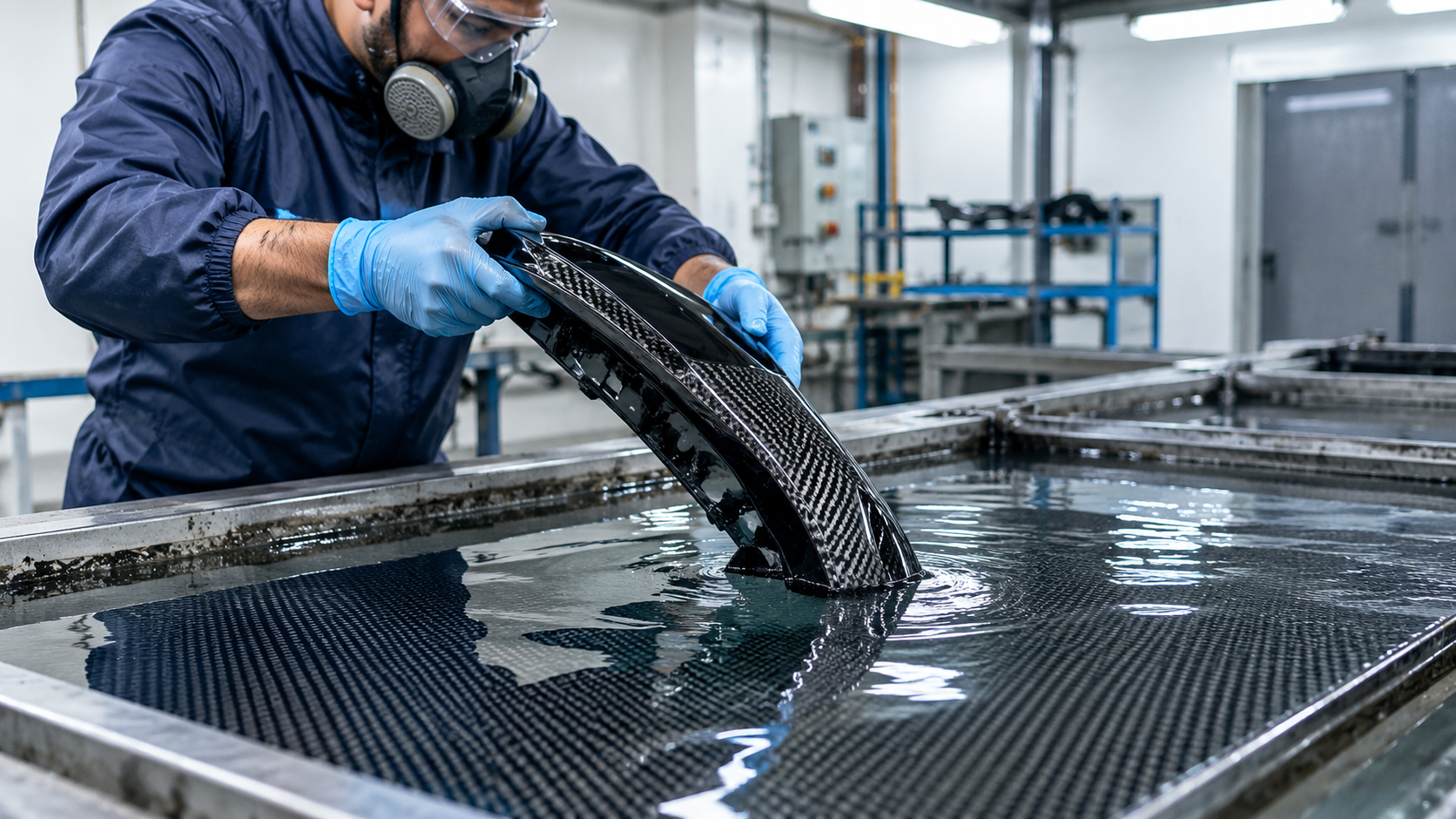
Complex 3D parts — dashboards, power tool housings, tactical gear — don't finish well under spray paint or vinyl wrap, which leave seams or stretched patterns on contoured surfaces. Hydro dipping, more formally water transfer printing, solves this by using water itself to wrap a printed film around the object, so the pattern follows every curve and recess without a seam.
How the process works
A water-soluble polyvinyl alcohol (PVA) film, pre-printed with the target pattern, is floated on a temperature-controlled water bath. A chemical activator sprayed over the film dissolves the PVA backing and primes the ink so it bonds to whatever passes through it. From there, industrial dipping runs through six controlled stages:
- Clean and prep the substrate — degreasing, ultrasonic cleaning, or flame/plasma treatment for low-surface-energy plastics.
- Apply primer and base coat — inks are semi-transparent, so the base coat color sets the final look.
- Hydrate and activate the film on the water's surface.
- Submerge the part at a controlled angle and speed, usually via robotic arm, so the ink wraps the contours without trapping air.
- Rinse away residual PVA gel, leaving only the bonded ink.
- Dry and apply a clear topcoat — typically a two-part polyurethane — for UV, chemical, and scratch resistance.
Water temperature and activator volume are the two variables that most often make or break the finish: too cold and the film won't hydrate properly; too much activator and the pattern blurs or washes out.
Why Manufacturers Choose It
- Seamless coverage on complex geometry — fluid dynamics let ink follow contours that vinyl or spray can't reach cleanly.
- Pattern changes without new tooling — one mould can ship in wood grain, carbon fiber, or camouflage just by swapping the film.
- Durability set by the coat system, not the ink — with the right topcoat, finished parts can match the scratch and weather resistance of automotive exterior paint.
- Scales with automation — continuous-flow tanks and robotic dipping arms keep large runs consistent part to part.
Where it's used
Dashboards, consoles, trim, lightweight composite interiors
Console housings, peripherals, appliance shells
Firearm components, bows, helmets, optics — camouflage patterns
ATV fairings, jet ski hulls, dashboard panels exposed to UV and salt
Material compatibility
ABS, polycarbonate
Standard degreasing; accepts base coat directly
Polypropylene, polyethylene
Adhesion promoter or flame treatment — low surface energy resists paint
Aluminum, steel
Sandblasting or chemical etching, then an etching/epoxy primer
MDF, wood
High-build sealer before dipping — unsealed porous surfaces swell
Glass, ceramics
Silane-based coupling agent for adhesion
Quality control
Three defects account for most industrial rejects: fish-eyes from surface contamination, stretched or faded patterns from incorrect dip angle or speed, and poor adhesion from uneven activator coverage.
All three are addressed the same way — tighter cleaning protocols, programmable dip angles, and overlapping activator spray patterns — which is why high-volume lines lean on automation rather than manual dipping.
Where Rustagi Polymers fits
Rustagi Polymers runs injection moulding and finishing — including hydrographic printing — from facilities in Noida and Greater Noida, so the moulded part and its finish come off a single production line rather than two separate vendors.
That's the same logic behind our integrated plastic manufacturing approach, and it pairs with mould cooling optimization when finish quality depends on a stable base surface. For OEMs and procurement teams sourcing finished plastic components, that means fewer handoffs and one point of accountability for fit, finish, and durability.
FAQ
1. Is a hydro-dipped finish durable enough for daily-use products?
Yes — durability comes from the base coat and clear topcoat, not the printed film itself. A properly coated part performs like any well-painted plastic or metal component.
2. Can hydro dipping run on standard PP or PE parts?
Yes, but only after adhesion promoters or flame treatment; both plastics naturally resist paint bonding without pre-treatment.
3. Does it work at production scale, or mainly for one-off customization?
Both. Manual dipping suits small runs and prototypes; continuous-flow tanks with robotic arms handle high-volume OEM production with consistent results part to part.
Ready to move a component from mould to finished, market-ready part? Get in touch with Rustagi Polymers to discuss your specification.