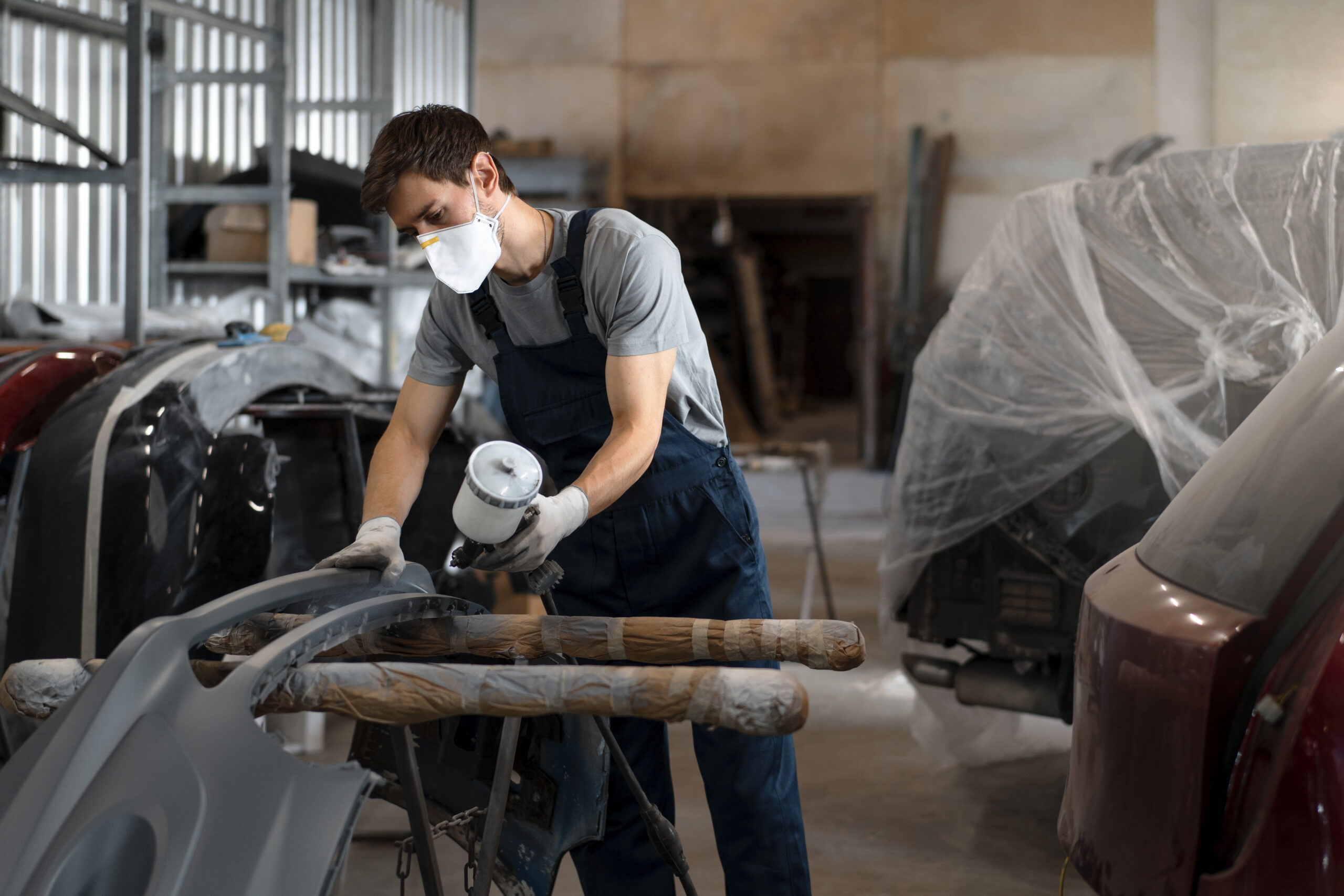
Have you ever noticed how a car dashboard looks premium even after all these years? Well, we know the answer. It’s two words: surface finishing. Whether you take a look at metal coatings or PU coatings on plastic, automotive finishing is not just about aesthetics.
The process of surface finishing goes beyond durability, compliance and brand perception. Surface finishing in automotive components is governed by strict technical requirements to ensure durability, aesthetics, and long-term performance.
What are the common surface finishing requirements
1. Visual and aesthetic requirements
- The most attractive thing, whether you want the gloss levels to be matte or high gloss.
- One needs to choose color tolerances i.e., Delta E ≤ 1.0 (premium interiors) or ≤ 1.5 (standard tolerance).
- Next, comes the uniform texture i.e., VDI or Mold-Tech texture standards.
The supplier needs to make sure that there are no defects (streaks, pinholes, uneven coating). For example, understanding how multi-color pad printing functions on plastic parts is essential for maintaining crisp, consistent branding across different interior components.
2. Adhesion Strength
- Firstly, coatings must bond firmly to substrate which means no peeling or flaking over time.
- The adhesion strength must pass cross-hatch adhesion strength before the automobile goes live.
For instance, in case of control buttons and branding, suppliers recommend foil stamping and high adhesion films to ensure crisp detailing and no fading.
3. Mechanical Performance
Automotive components require high scratch resistance for high-touch areas. In case of repeated use, abrasion resistance is required. The performance is especially critical for exterior components, thereby impact resistance is highly important.
4. Chemical Resistance
Suppliers must ensure that there is no discoloration or degradation. Additionally, the automotive parts should be resistant to:
- Sweat and oils
- Cleaning agents
- Fuels and lubricants
5. Environmental Durability
To ensure environmental durability, suppliers need to ensure the following conditions:
- UV resistance (no fading/yellowing)
- Thermal stability (-40°C to +85°C)
- Humidity resistance (no blistering)
6. Coating Thickness and Uniformity
Even distribution across geometry is key to ensure coating thickness and uniformity. Controlled thickness (microns) results in even distribution and delivers excellence.
This parameter checks the quality of the output wherein no pooling or thin spots are spotted.
It is important for engineers to understand how spray coating affects thin walls, small features, and precision components to avoid pooling or thin spots in complex designs.
7. Surface Preparation
Coating adhesion requires correct surface energy, which requires a dust-free environment. Proper cleaning and activation are key elements of this application.
To make sure that the process is consistent and efficient, it is necessary to add protective layers to external components.
8. Multi-Process Integration
The last key requirement is multi-process integration. From the single component requirement for vacuum metalizing near me to meeting all surface preparation checkpoints, every process must meet OEM-defined standards.
Case Study
A luxury car brand is launching a new EV in the automobile market. Their requirement is simple yet powerful enough to attract modern car buyers.
Challenge: Require a soft-touch matte dashboard, zero glare, and it must survive 5+ years of UV exposure.
Solution: Using PU coating with anti-scratch additives and UV stabilisers.
After further discussion, the OEM designer and supplier agreed to add gloss level to below 5 GU at 60°. No color shift under sunlight. Here, we noticed that surface finishing details are precised and defined. This is where engineering meets perception and surface finishing is delivered as a complete solution.
Final Takeaway
Surface finishing is where engineering meets perception. It ensures that automotive parts not only perform well but also deliver a premium user experience. Manufacturers that offer integrated solutions—from surface preparation to final finishing—are better equipped to maintain consistency and quality.
To ensure this level of reliability, it is vital to understand how quality systems impact long-term consistency in injection molding production. One such manufacturing company is Rustagi Polymers which offers integrated finishing solutions and lists multiple services under one roof.
Frequently Asked Questions (FAQs)
1. What finishing specifications do OEMs typically request for interior panels?
For interior panels, OEMs require low gloss (anti-glare surfaces), tight color tolerances (Delta E ≤ 1.0), soft-touch or matte textures.
2. How should suppliers document lot traceability for films, inks, and coatings?
Suppliers must maintain operator details, production logs, raw material batch numbers and process parameters including curing cycles and temperatures. This ensures fast defect resolution and traceability.
3. When is vacuum metalizing preferred over hydrographics or painting?
Usually, vacuum metalizing is a preferred solution in case of trims, logos and decorative parts. In this case, complex shapes need uniform coating and high reflectivity or chrome finishing is required.
4. How do PU coatings improve wear and chemical resistance?
PU coatings oversee the following actions:
- Resist scratches and abrasion
- Protect against oils, solvents, and cleaners
- Prevent fading under UV exposure
5. What adhesion tests are required after coating or metallizing?
To ensure that coating is intact under stress, peel strength testing, tape test and cross-hatch adhesion test are recommended.
6. How are gloss and colour tolerances specified for interior components?
This specification takes place in batch-to-batch operations wherein color is measured using spectrophotometers and gloss is measured in Gloss Units (GU). For tracking, delta E defines acceptable variation.
7. What anti-scratch or hard-coat systems are used for high-touch surfaces?
High-touch surfaces including buttons, control panels and interior trims require the following systems:
- UV-cured hard coatings
- PU-based protective layers
- Clear topcoats over metallized parts