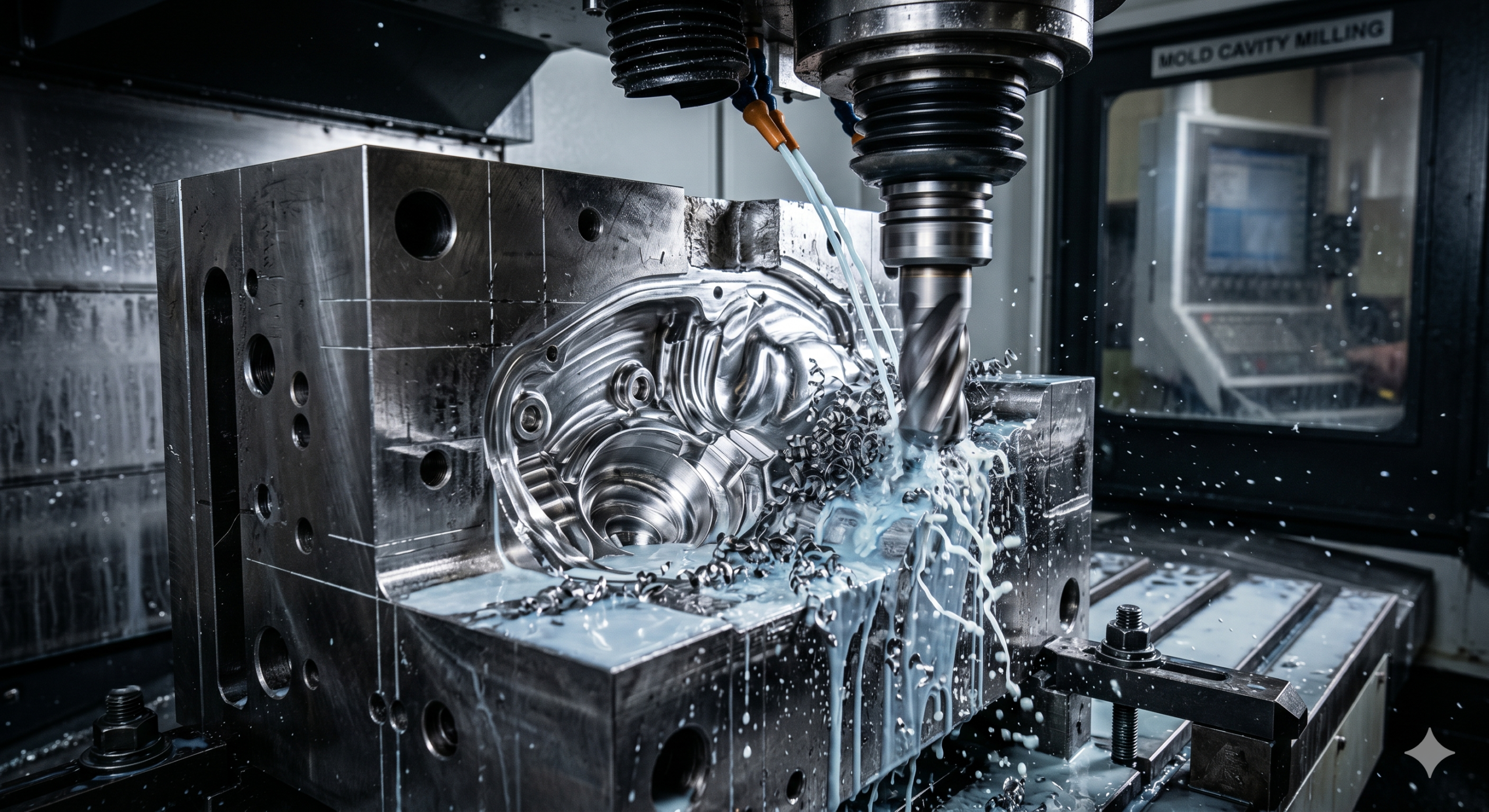
We hear it all the time from buyers visiting our facility. They walk in, look at the plastic injection moulding machines, check the tonnage ratings and the platen sizes, and start making assumptions about capability. Bigger machine, better parts, right?
Wrong. And we'll tell you exactly why.
At Rustagi Polymers, we offer injection mold services, hydro water transfer printing, plastic painting service. We've got years of data on what actually drives quality and efficiency in injection moulded production. Tooling is the answer. Every single time.
How Does In-House Tooling Improve Production Efficiency?
When your tooling is made and maintained in-house, you control the whole loop. Something goes wrong with a mould such as a cooling channel gets partially blocked, a gate erodes, an ejector pin starts sticking, you find out immediately and fix it the same day. Maybe the same shift.
Outsourced tooling means shipping the mould out, waiting days or weeks, losing production time. Then when it comes back, your setup team has to re-establish all the process parameters. Every time.
In-house tooling benefits:
- Rapid mould modifications includes design iterations take days, not weeks
- Immediate troubleshooting during production
- Better institutional knowledge means your toolmakers know your moulds intimately
- Tighter control over tool steel quality and construction standards
- Faster ramp-up for new projects
Why Tooling is Often More Important Than Machine Size
A well-designed mould running on a correctly matched machine will always outperform a poor mould on a larger machine. Here's the technical reality:
- Gate design controls fill pattern, weld line location, and residual stress
- Cooling channel layout determines cycle time and warpage
- Venting affects burn marks, short shots, and surface quality
- Ejection system design affects part distortion and cycle speed
None of these are improved by simply increasing machine tonnage. In fact, oversized machines can mask tooling problems. Imagine, you just clamp harder instead of fixing the real issue.
For a detailed breakdown of what these variables mean in measurable terms, injection molding tolerances and what engineers can expect during manufacturing covers exactly what dimensional outcomes tooling decisions drive — and where the limits are.
Example:
Challenge: A packaging client was struggling with a 650T machine elsewhere, getting warped parts.
Solution: Running the same product on the 350T machine with a revised cooling layout while adding baffles in the tool.
Result: Warpage reduced by 80%. The original tool was simply running too hot.
How Does In-House Tooling Reduce Lead Time?
A new project at a plastic molding company goes through tool design, fabrication, trial, and first article approval all under one roof. There's no translation loss between teams in different locations. When the mold designer and the plastic injection molding team share a floor, problems get solved over a conversation rather than a chain of emails.
Typical lead time comparison:
- External tooling and external moulding: 12-16 weeks tool build, then qualification, then production
- In-house tooling and in-house moulding: 8-10 weeks total for straightforward tools
- Modifications post-first-article: Days in-house vs. weeks external
What Cost Savings Come From In-House Tooling?
Direct savings are obvious with no external toolmaker margin, no freight on heavy steel moulds, no idle machine time while waiting for tool repairs.
Indirect savings are bigger:
- Fewer rejected parts from better-optimised tooling
- Lower scrap rates from faster process stabilisation
- No emergency freight charges when something breaks at 11pm on a Friday
- Process improvements that pay back across thousands of cycles
For a high-volume injection moulded component running at, say, 500,000 parts per year, even a 2-second cycle time reduction from better cooling design saves hundreds of machine hours annually. That's significant. For manufacturers at that scale, the next step is often scaling from single cavity mold to multi-cavity production — a transition where in-house tooling capability becomes even more critical to getting cavity balance and consistency right."
How Does In-House Tooling Affect Part Quality?
Dramatically. And the reasons are both technical and organisational, as listed below:
Technically: Moulds built in-house to your own standards tend to have better surface finishes, tighter dimensional control, and more thoughtfully designed cooling and venting.
Organisationally: When the people making the mould are also the people running production, feedback loops are tight and fast. A mould setter who sees a quality issue can walk to the toolroom and show the toolmaker exactly what's happening.
- Better gate locations reduce visible weld lines
- Optimised cooling reduces cycle time and improves dimensional stability
- Consistent ejection system design reduces part distortion
- Better venting reduces burn marks and cosmetic defects
Can Small Machines Perform as Well as Larger Ones With Proper Tooling?
Yes. Within their clamping force range, absolutely.
The key is matching tool design to machine capability. A small machine with a well-designed tool and correct gate sizing for the available injection pressure, proper cooling for the available water flow, balanced runner system will produce identical quality to a large machine running an oversized, underoptimised tool.
Where small machines fall short is when the tool design simply demands more clamp force than they can provide, which is the case for large parts with thin walls and high injection pressures. But that's a tool design and material selection issue, not a machine size issue per se.
Conclusion
In-house tooling shifts the advantage from brute force to precision. It shortens feedback loops, enables faster iterations, and ensures that every mould is optimised not just once, but continuously over its lifecycle. The result is not only better part quality, but also faster production, lower costs, and more predictable outcomes.
Meeting surface finishing requirements for automotive parts starts with the mould, not the paint booth. At Rustagi Polymers, our plastic injection mold services are built around matching the right tool design to the right machine.
FAQs
1. How does in-house tooling improve production efficiency?
It allows immediate troubleshooting, quick responses and eliminates downtime caused by sending moulds to external vendors. This keeps production stable and efficient.
2. Why is tooling often more important than machine size?
Machine size just determines maximum clamp force. Everything about part quality i.e., fill pattern, cooling, ejection, surface finish is determined by tool design.
3. How does in-house tooling reduce lead time?
Design, build, trial, and modify all happen in one place. This eliminates logistics delays and communication gaps between separate suppliers.
4. What cost savings come from in-house tooling?
Savings include no external vendor margins, reduced downtime, lower scrap rates, fewer rejected parts, and elimination of emergency logistics costs.
5. How does in-house tooling affect part quality?
A: It improves consistency, dimensional accuracy, and surface finish. Faster feedback between production and toolmaking teams ensures defects are quickly corrected and do not repeat across batches.
6. Can small machines perform as well as larger ones with proper tooling?
Yes. When tooling is optimised for the machine’s capabilities, smaller machines can produce parts with the same quality and consistency as larger ones, as long as clamp force requirements are met.